Last updated: June 23, 2026
MLVSS Calculator

Creators
Dharmendra SinghReviewers
Creators
Dharmendra SinghReviewers
Quick Answer
The MLVSS Calculator determines Mixed Liquor Volatile Suspended Solids using the gravimetric loss-on-ignition method: MLVSS (mg/L) = (dried weight − ignited weight) ÷ sample volume × 1000. From the tare, dried (103–105 °C), and ignited (550 °C) weights plus sample volume, it also returns MLSS (total suspended solids), the fixed (ash) solids, and the VSS/TSS ratio. MLVSS estimates the active biomass in an activated-sludge aeration basin and is used for F/M ratio and sludge age calculations.
To calculate MLVSS, subtract the ignited weight from the dried weight, divide by the sample volume in millilitres, and multiply by one thousand. For example, a 24-milligram loss on ignition from a 10-millilitre sample gives 2400 milligrams per litre of volatile suspended solids.
Key Takeaways
- MLVSS = (dried weight − ignited weight) ÷ sample volume × 1000, in mg/L
- MLVSS is the volatile (organic) fraction of MLSS — a practical proxy for active biomass
- A healthy activated sludge has a VSS/TSS ratio of about 70–85%
- Total solids are dried at 103–105 °C; volatile solids burn off at 550 °C
- MLVSS drives F/M ratio and sludge age (SRT) — core activated-sludge process controls
Creators
Dharmendra SinghReviewers
Creators
Dharmendra SinghReviewers
Formula
MLVSS = (Dried − Ignited) / Volume × 1000
Where:
- MLVSS=Mixed Liquor Volatile Suspended Solids(mg/L)
- W_{dried}=Dish + solids weight after drying at 103–105 °C(mg)
- W_{ignited}=Dish + ash weight after ignition at 550 °C(mg)
- V=Volume of mixed-liquor sample filtered(mL)
Worked Examples
Standard Activated Sludge (80% Volatile)
A 10 mL mixed-liquor sample filtered, dried at 105 °C, then ignited at 550 °C.
- 1MLSS = (25030 − 25000) / 10 × 1000 = 3000 mg/L
- 2MLVSS = (25030 − 25006) / 10 × 1000 = 2400 mg/L
- 3Fixed solids = (25006 − 25000) / 10 × 1000 = 600 mg/L
- 4VSS/TSS = 2400 / 3000 × 100 = 80% (healthy)
Lower-Strength Mixed Liquor (76% Volatile)
A 25 mL sample from a plant treating diluted municipal wastewater.
- 1MLSS = (24550 − 24500) / 25 × 1000 = 2000 mg/L
- 2MLVSS = (24550 − 24512) / 25 × 1000 = 1520 mg/L
- 3Fixed solids = (24512 − 24500) / 25 × 1000 = 480 mg/L
- 4VSS/TSS = 1520 / 2000 × 100 = 76%
Quick Estimate from MLSS and Ratio
If you already know MLSS and the typical volatile fraction, MLVSS = MLSS × ratio.
- 1Gravimetric: MLSS = (20035 − 20000) / 10 × 1000 = 3500 mg/L
- 2MLVSS = (20035 − 20007) / 10 × 1000 = 2800 mg/L
- 3VSS/TSS = 2800 / 3500 × 100 = 80%
- 4Shortcut check: 3500 mg/L × 0.80 = 2800 mg/L ✓
Introduction
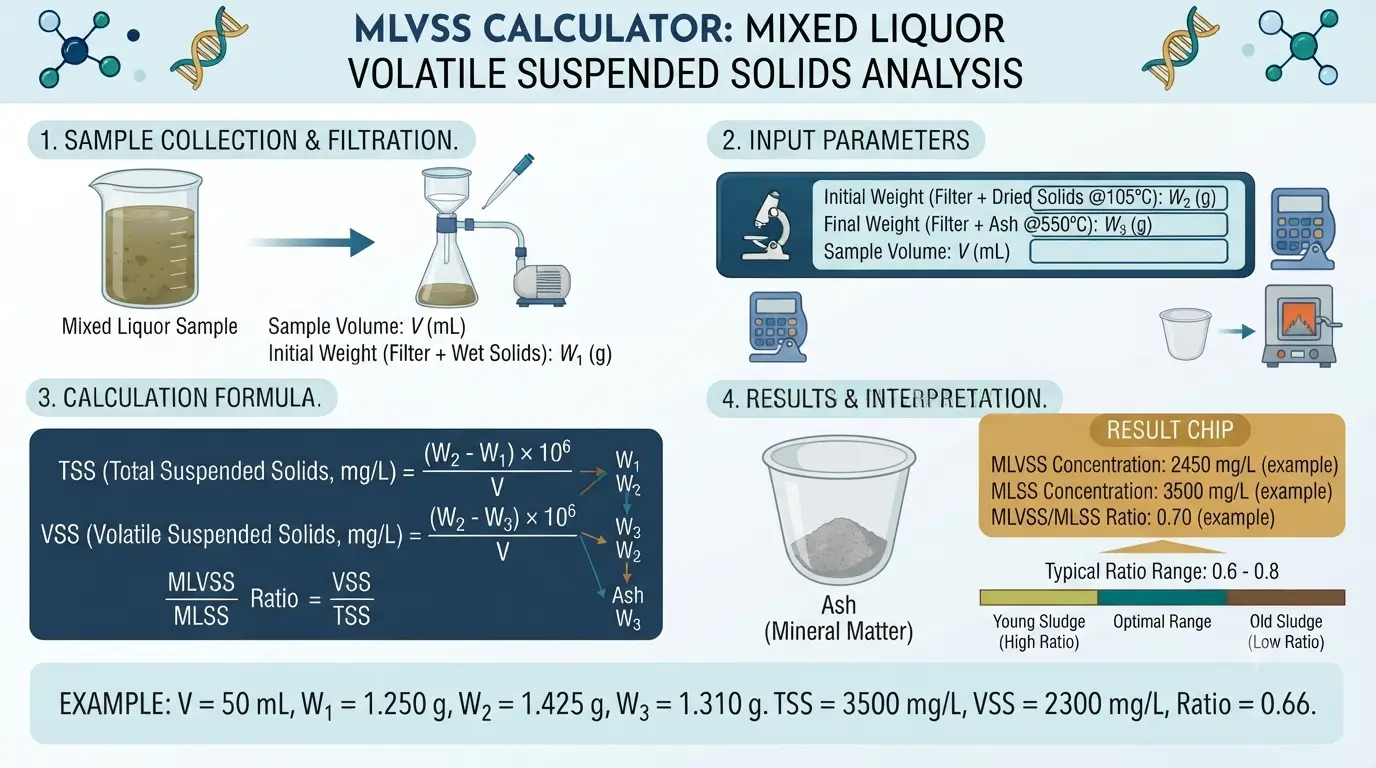
The MLVSS Calculator determines Mixed Liquor Volatile Suspended Solids (MLVSS) — the organic, biologically active fraction of the suspended solids in an activated-sludge aeration basin — using the standard gravimetric *loss on ignition* method (APHA Standard Methods 2540 D/E). You enter four lab weights — the tare dish, the dish after drying at 103–105 °C, the dish after ignition at 550 °C, and the sample volume — and the calculator returns MLVSS, MLSS, the fixed (ash) solids, and the VSS/TSS ratio. MLVSS is the best routine estimate of the microbial biomass that actually treats the wastewater, so it drives F/M ratio, sludge age (SRT), and other process-control decisions. For related process math, see our wastewater calculator.
How the MLVSS Calculation Works
MLVSS is measured, not guessed: the suspended solids are dried to a constant weight to find the total (MLSS), then ignited at 550 °C to burn off the organic matter. Whatever weight is lost on ignition was volatile (organic = biomass); whatever remains is fixed (inorganic ash). Dividing each by the sample volume converts milligrams into mg/L.
Filter a known volume of mixed liquor through a pre-weighed (tare) glass-fiber filter or dish
Dry at 103–105 °C to constant weight and reweigh → total suspended solids (MLSS)
Ignite at 550 °C for ~15–20 min, cool, and reweigh → fixed (inorganic) solids remain as ash
MLVSS = (dried − ignited) ÷ volume × 1000 — the organic mass lost on ignition
VSS/TSS ratio = MLVSS ÷ MLSS × 100 — a quick health check on the biomass fraction
What Is MLVSS and Why It Matters
In the activated-sludge process, a tank of wastewater is mixed with a dense population of microorganisms ('mixed liquor'). The suspended solids in that tank include living biomass, dead cells, and inert mineral matter. MLVSS isolates the volatile (organic) portion, which closely tracks the active biomass doing the treatment — making it far more useful than total solids for process control.
MLSS = all suspended solids in the aeration tank (organic + inorganic)
MLVSS = the volatile (organic) fraction — a practical proxy for living biomass
Fixed solids = the inorganic ash (grit, silt, precipitated minerals)
MLVSS feeds the F/M ratio (food-to-microorganism) and sludge age (SRT) calculations
Tracking MLVSS trends helps operators keep the right amount of biomass in the system
MLSS, MLVSS, TSS, VSS — Key Terms
These acronyms are closely related and easy to mix up. The 'ML' prefix simply means the measurement was taken on the mixed liquor inside the aeration basin.
| Term | Stands For | Meaning |
|---|---|---|
| TSS | Total Suspended Solids | All filterable solids in a water sample (mg/L) |
| VSS | Volatile Suspended Solids | The organic fraction of TSS, lost on ignition at 550 °C |
| MLSS | Mixed Liquor Suspended Solids | TSS measured in the aeration-basin mixed liquor |
| MLVSS | Mixed Liquor Volatile SS | VSS measured in the mixed liquor — the active biomass proxy |
| FSS | Fixed Suspended Solids | The inorganic ash remaining after ignition (MLSS − MLVSS) |
Interpreting the VSS/TSS Ratio
The VSS/TSS ratio (the volatile fraction) is a quick indicator of mixed-liquor quality. A healthy municipal activated sludge is mostly organic; a low ratio signals dilution by inert material.
| VSS/TSS Ratio | Interpretation | Typical Situation |
|---|---|---|
| 80–90% | Very high organic fraction | Strong/industrial organic load, young sludge |
| 70–85% | Healthy municipal range | Typical conventional activated sludge |
| 60–70% | Moderate — some inert load | Older sludge or higher inorganic influent |
| < 60% | Low — high inorganic fraction | Grit/silt intrusion, chemical addition, I&I |
There is no single 'correct' ratio — it depends on the influent and process. What matters most is a stable trend; a sudden drop often points to grit, chemical precipitation, or infiltration.
Where MLVSS Is Used
MLVSS is one of the most-used numbers in day-to-day wastewater plant operation because it stands in for the active biomass that the whole process depends on.
Food-to-Microorganism (F/M) ratio = BOD load ÷ (MLVSS × tank volume)
Mean Cell Residence Time / Sludge Age (SRT) calculations
Setting the wasting (WAS) and return (RAS) sludge rates
Sizing and troubleshooting aeration-basin biomass inventory
Specific oxygen uptake rate (SOUR) and other biomass-normalized metrics
Research on biological treatment kinetics and yield coefficients
The Gravimetric Lab Procedure (2540 D/E)
Accurate MLVSS depends on careful, consistent technique. The procedure below follows APHA Standard Methods 2540 D (total suspended solids) and 2540 E (fixed and volatile solids).
Pre-fire and pre-weigh the glass-fiber filter or dish (the tare weight)
Mix the sample well and filter a measured volume — choose a volume giving 2.5–200 mg of residue
Dry at 103–105 °C to constant weight, cool in a desiccator, and weigh → MLSS
Ignite the same residue at 550 °C ± 50 °C for 15–20 minutes
Cool in a desiccator and reweigh → the loss is the volatile (MLVSS) fraction
Run duplicates and average; report to the nearest whole mg/L
The MLSS × Ratio Shortcut
When the muffle furnace step isn't run daily, operators often estimate MLVSS from a routine MLSS reading and a known historical volatile fraction: MLVSS = MLSS × (VSS/TSS). This is convenient but only as good as the assumed ratio.
Example: MLSS 3500 mg/L × 0.80 = 2800 mg/L MLVSS
Use a ratio derived from your own plant's recent ignition tests, not a generic value
Re-verify the ratio with a full gravimetric test whenever the influent changes
The shortcut drifts if grit, chemicals, or infiltration shift the inorganic load
For F/M and SRT reporting, periodic true MLVSS measurements are still required
Treat the ratio shortcut as an interpolation between real ignition tests — handy for daily trending, but not a replacement for the 550 °C measurement.
Factors That Affect MLVSS Accuracy
Several practical issues can bias the result. Being aware of them keeps your numbers reproducible and defensible.
- Incomplete drying:
residual moisture inflates both MLSS and MLVSS — dry to constant weight
- Over-ignition:
temperatures above ~550 °C can decompose mineral carbonates, overstating volatile loss
- Sample volume:
too little residue increases weighing error; too much can clog the filter
- Desiccator handling:
samples must cool fully and not reabsorb moisture before weighing
- Poor mixing:
a non-representative aliquot skews the whole result
- Balance precision:
use an analytical balance (0.1 mg) — these are small mass differences
Because MLVSS is a difference of two large, similar weights, small weighing errors are magnified. Consistent technique and a calibrated analytical balance are essential.
Common Mistakes to Avoid
Most MLVSS errors come from procedure and unit slips rather than the math. Avoid these to keep results trustworthy.
Mixing up the dried and ignited weights — dried must be the larger value
Entering grams instead of milligrams, or litres instead of millilitres
Forgetting to subtract the tare dish weight
Assuming a fixed 0.80 ratio instead of measuring it for your plant
Reporting MLVSS without noting the sample volume and date
Using a clogged or partially-bypassed filter, which loses fine solids
Activated-Sludge Solids Glossary
Key terms used in MLVSS testing and activated-sludge process control.
| Term | Definition |
|---|---|
| Mixed liquor | The mixture of wastewater and microorganisms in the aeration basin. |
| MLSS | Mixed Liquor Suspended Solids — total suspended solids in the mixed liquor (mg/L). |
| MLVSS | Mixed Liquor Volatile Suspended Solids — the organic/biomass fraction (mg/L). |
| VSS/TSS ratio | The volatile fraction of suspended solids, expressed as a percentage. |
| Loss on ignition | The weight lost when dried solids are ignited at 550 °C — the volatile fraction. |
| Fixed solids | The inorganic ash remaining after ignition (MLSS − MLVSS). |
| F/M ratio | Food-to-Microorganism ratio — BOD load per unit of MLVSS biomass. |
| SRT / sludge age | Mean cell residence time — average time biomass stays in the system. |
| RAS / WAS | Return Activated Sludge and Waste Activated Sludge streams. |
| Standard Methods | APHA/AWWA/WEF reference methods (2540 D/E) for solids analysis. |
Quick Reference Card
MLVSS — Quick Reference
Quick reference • MLVSS Calculator
MLVSS = (dried − ignited) / volume × 1000 (mg/L)Valid range: VSS/TSS typically 70–85%; MLSS often 2000–4000 mg/L
Common Values
⚠ Watch Out
- •Dried weight must be greater than ignited weight
- •Enter milligrams and millilitres, not grams or litres
- •Always subtract the tare dish weight
- •Measure the VSS/TSS ratio for your plant — don't assume 0.80
Pro Tips
- →Use an analytical balance (0.1 mg) and a desiccator for cooling
- →Run duplicate filters and average the result
- →Choose a sample volume giving 2.5–200 mg of residue
- →Track MLVSS trends, not single readings, for process control
FAQs
What is MLVSS?
MLVSS stands for Mixed Liquor Volatile Suspended Solids — the organic (volatile) fraction of the suspended solids in an activated-sludge aeration basin. It is measured by drying a filtered sample at 103–105 °C, then igniting it at 550 °C; the weight lost on ignition, divided by the sample volume, is the MLVSS in mg/L. It serves as a practical estimate of the active microbial biomass treating the wastewater.
How do you calculate MLVSS?
Using the gravimetric loss-on-ignition method: MLVSS (mg/L) = (dried weight − ignited weight) ÷ sample volume × 1000, where weights are in mg and volume in mL. For example, a dish going from 25,030 mg (after 105 °C drying) to 25,006 mg (after 550 °C ignition) on a 10 mL sample gives (25,030 − 25,006) ÷ 10 × 1000 = 2400 mg/L MLVSS.
What is the difference between MLSS and MLVSS?
MLSS (Mixed Liquor Suspended Solids) is the TOTAL suspended solids in the mixed liquor — organic plus inorganic. MLVSS (Mixed Liquor Volatile Suspended Solids) is only the VOLATILE (organic) portion, found by burning off the organic matter at 550 °C. MLVSS is always less than or equal to MLSS, and the ratio MLVSS/MLSS (typically 0.70–0.85) indicates how much of the sludge is active biomass versus inert material.
What is a good MLVSS/MLSS ratio?
For conventional municipal activated sludge, a VSS/TSS ratio of about 70–85% is typical and healthy. Higher ratios (80–90%) indicate a strongly organic load, while ratios below 60% suggest a high inorganic fraction from grit, silt, chemical addition, or infiltration. There is no single correct value — a stable trend matters more than the absolute number.
Why is MLVSS used instead of MLSS for F/M ratio?
The food-to-microorganism (F/M) ratio compares the incoming organic load (BOD) to the amount of biomass available to consume it. Because MLVSS represents the organic, biologically active solids and excludes inert mineral matter, it is a better proxy for the living biomass than total MLSS. Using MLVSS makes the F/M ratio a more accurate process-control parameter.
What temperature is used to measure volatile solids?
Volatile suspended solids are determined by ignition at 550 °C ± 50 °C, per APHA Standard Methods 2540 E. At this temperature the organic matter combusts and is driven off as gas, while the inorganic (fixed) solids remain as ash. The sample is first dried at 103–105 °C to measure total suspended solids before ignition.
Can I estimate MLVSS without a muffle furnace?
Yes, approximately. If you know your plant's typical VSS/TSS ratio from past ignition tests, you can estimate MLVSS = MLSS × ratio (e.g., 3000 mg/L × 0.80 = 2400 mg/L). This shortcut is useful for daily trending but is only as accurate as the assumed ratio, which drifts when the influent changes — so periodic true 550 °C measurements are still needed.
What units does the MLVSS calculator use?
Enter the three weights (tare, dried, ignited) in milligrams and the sample volume in millilitres. The calculator returns MLVSS, MLSS, and fixed solids in mg/L, plus the VSS/TSS ratio as a percentage. If your balance reads grams, convert to mg first (1 g = 1000 mg); the millilitre-to-litre conversion is handled by the ×1000 factor in the formula.
Why did the calculator return zeros?
The calculator returns zeros when the inputs are physically impossible or invalid: the dried weight must be greater than or equal to the ignited weight (you can't gain mass on ignition), the ignited weight must be at least the tare weight, the sample volume must be positive, and all entries must be valid numbers. Double-check that you entered dried > ignited > tare and a non-zero volume.
Is MLVSS the same as biomass concentration?
MLVSS is a close proxy for biomass but not a perfect one. It includes all volatile solids — living cells, dead cells, and non-cellular organic matter — so it slightly overestimates the truly active biomass. Despite this, MLVSS is the standard, practical, and reproducible measure used in process control because direct measurement of viable biomass is impractical for routine operation.