Last updated: May 24, 2026
Benadryl Dosage Calculator for Dogs

Creators
Dharmendra SinghReviewers
Creators
Dharmendra SinghReviewers
Quick Answer
Benadryl (diphenhydramine) for dogs is dosed at 1 mg per pound of body weight using Dosage (mg) = Weight (lbs) × 1 mg/lb, given every 8–12 hours, so a 50 lb dog receives 50 mg, which equals two 25 mg tablets. This free calculator converts your dog's weight into the exact milligram dose and the practical amount of tablets, chewables, or liquid; always use plain diphenhydramine products with no added decongestants or pain relievers and confirm the dose with your veterinarian.
To dose Benadryl for a dog, give one milligram of diphenhydramine per pound of body weight, two to three times a day; for example, a fifty pound dog gets fifty milligrams, which is two twenty-five milligram tablets.
Key Takeaways
- Dog Benadryl dose: 1 mg diphenhydramine per pound of body weight, every 8–12 hours (2–3× daily).
- A 25 lb dog needs 25 mg (one adult tablet); a 50 lb dog needs 50 mg (two tablets).
- Use ONLY plain diphenhydramine — combination cold/flu products with acetaminophen or decongestants are toxic.
- Benadryl works in 30–60 minutes and lasts 8–12 hours; mild drowsiness is the most common effect.
- Confirm the dose with your vet first, especially for puppies or dogs with glaucoma, heart, or seizure conditions.
Creators
Dharmendra SinghReviewers
Creators
Dharmendra SinghReviewers
Formula
Dosage (mg) = Weight (lbs) × 1 mg/lb
Where:
- D=Dosage in milligrams(mg)
- W=Dog's body weight(lbs)
- 1 mg/lb=Standard veterinary dosing rate(mg/lb)
Worked Examples
Medium Dog — Tablet
A 50-pound Labrador needs Benadryl for allergic hives. Adult 25 mg tablets available.
- 1Weight in lbs = 50
- 2Dosage = 50 × 1 mg/lb = 50 mg
- 3Tablets = 50 mg ÷ 25 mg/tablet = 2 tablets
Small Dog — Liquid
A 10-pound Chihuahua with seasonal allergies. Children's liquid Benadryl (12.5 mg/5 mL).
- 1Weight in lbs = 10
- 2Dosage = 10 × 1 mg/lb = 10 mg
- 3Volume = (10 mg ÷ 12.5 mg) × 5 mL = 4 mL
Large Dog — Kg Input
A 30 kg German Shepherd with bee sting reaction. Adult tablets.
- 1Convert: 30 kg × 2.205 = 66.1 lbs
- 2Dosage = 66.1 × 1 mg/lb = 66 mg
- 3Tablets = 66 mg ÷ 25 mg/tablet ≈ 2.5 tablets (round to 2.5)
Toy Breed — Chewable
A 6-pound Yorkshire Terrier with itchy, irritated skin. Children's chewable tablets (12.5 mg) available.
- 1Weight in lbs = 6
- 2Dosage = 6 × 1 mg/lb = 6 mg
- 3Chewables = 6 mg ÷ 12.5 mg ≈ ½ chewable tablet (liquid is more precise for toy breeds)
Introduction
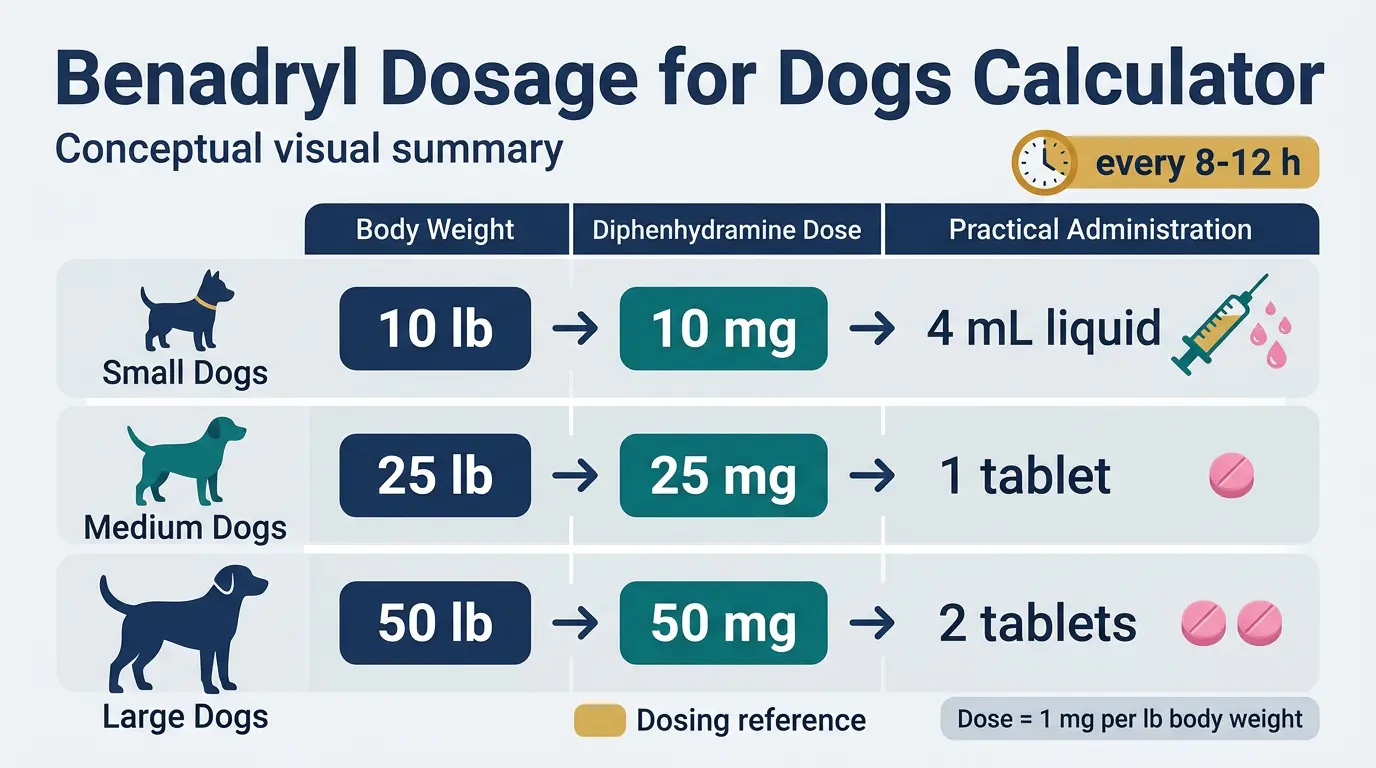
The Benadryl Dosage Calculator for Dogs helps pet owners and veterinary professionals determine a safe diphenhydramine dose for canine patients in seconds. Benadryl is widely used in veterinary medicine to manage allergic reactions, insect stings, itching, motion sickness, and mild anxiety. The standard dose is 1 mg of diphenhydramine per pound of body weight, given every 8–12 hours (2–3 times daily). Enter your dog's weight and the product you have on hand, and the calculator returns the exact milligram dose plus the practical amount — tablets, chewables, or milliliters of liquid. For more pet-health tools, see our dog food calculator, dog chocolate toxicity calculator, and the companion cat Benadryl dosage calculator.
How Benadryl Dosing Works for Dogs
The dosing math is simple: multiply your dog's weight in pounds by 1 mg to get the dose in milligrams. If you weigh your dog in kilograms, convert first by multiplying by 2.205. The calculator then translates that milligram dose into the practical amount for the formulation you select — how many 25 mg tablets, how many 12.5 mg chewables, or how many milliliters of 12.5 mg/5 mL liquid. This two-step approach (mg first, then product amount) is exactly how veterinarians prescribe at-home antihistamines. For body-condition tracking, see our dog BMI calculator.
Standard dose: 1 mg diphenhydramine per 1 lb of body weight
Frequency: every 8–12 hours (2–3 times daily)
Adult tablets contain 25 mg each
Children's liquid contains 12.5 mg per 5 mL
Children's chewables contain 12.5 mg each
Tablets to give = dose (mg) ÷ 25; Liquid (mL) = dose (mg) ÷ 12.5 × 5
Round to a practical, easy-to-administer amount — for a 66 mg result, 2.5 tablets is appropriate. When in doubt, round down and confirm with your vet.
Benadryl Dosage Chart for Dogs by Weight
Use this quick-reference chart to see the recommended diphenhydramine dose and the practical amount for common dog weights. Doses are based on the standard 1 mg/lb rate, given 2–3 times daily. Liquid is ideal for small dogs because it allows precise, fractional dosing, while tablets are usually easier for medium and large dogs.
| Dog Weight | Dose (mg) | 25 mg Tablets | 12.5 mg/5 mL Liquid |
|---|---|---|---|
| 5 lb | 5 mg | — | 2 mL |
| 10 lb | 10 mg | — | 4 mL |
| 15 lb | 15 mg | ½ tablet | 6 mL |
| 25 lb | 25 mg | 1 tablet | 10 mL |
| 35 lb | 35 mg | 1.5 tablets | 14 mL |
| 50 lb | 50 mg | 2 tablets | 20 mL |
| 75 lb | 75 mg | 3 tablets | 30 mL |
| 100 lb | 100 mg | 4 tablets | 40 mL |
For dogs under 15 lb, liquid or a split chewable gives more accurate dosing than cutting a 25 mg tablet. Liquid volumes become impractical for large dogs, so tablets are preferred above ~30 lb.
Metric Benadryl Dosage Chart (mg/kg) for Dogs
If you weigh your dog in kilograms, the same 1 mg/lb rate works out to roughly 2.2 mg per kilogram of body weight. Multiply your dog's weight in kg by 2.2 to get the dose in milligrams, then choose the practical amount below.
| Dog Weight (kg) | Dose (mg) | 25 mg Tablets |
|---|---|---|
| 5 kg (11 lb) | 11 mg | ½ tablet |
| 10 kg (22 lb) | 22 mg | ~1 tablet |
| 15 kg (33 lb) | 33 mg | 1.5 tablets |
| 20 kg (44 lb) | 44 mg | ~1.75 tablets |
| 25 kg (55 lb) | 55 mg | ~2 tablets |
| 30 kg (66 lb) | 66 mg | 2.5 tablets |
| 40 kg (88 lb) | 88 mg | 3.5 tablets |
The calculator does the kg-to-lb conversion automatically — just switch the weight unit to kilograms and enter the number.
How to Give Your Dog Benadryl
Getting the dose into your dog matters as much as the math. Diphenhydramine can be given with or without food, though a small treat helps with palatability and reduces stomach upset.
Hide tablets or chewables in a treat, pill pocket, or spoon of food
Use an oral dosing syringe for liquid, aimed at the cheek pouch
Give with a little food if your dog has a sensitive stomach
Never crush or split time-release/capsule products
Space doses 8–12 hours apart; do not double up if a dose is missed
Effects start in about 30 minutes, so give Benadryl ~30–60 minutes before a known trigger such as a car trip or fireworks.
When to Use Benadryl for Dogs
Benadryl is appropriate for several common conditions, but first-time use should always be cleared with your veterinarian — especially to rule out emergencies like a severe allergic reaction (anaphylaxis), which needs urgent care, not an at-home antihistamine.
Acute allergic reactions (hives, facial swelling, insect stings)
Seasonal/environmental allergies causing itching, sneezing, watery eyes
Motion sickness during car or air travel
Mild situational anxiety (thunderstorms, fireworks)
Pre-treatment before vaccines or insect-season outings (vet-directed)
Mild sedation to ease grooming or travel
Facial swelling, difficulty breathing, collapse, or vomiting after a sting or new food can signal anaphylaxis — seek emergency veterinary care immediately rather than waiting for Benadryl to work.
Benadryl for Bee Stings, Vaccines, and Grooming
A few situations come up again and again with at-home Benadryl. Knowing the plan in advance helps you act quickly and safely.
- Bee or wasp stings:
give the standard 1 mg/lb dose at the first sign of swelling, then watch closely for 30–60 minutes
- Vaccine reactions:
some vets pre-dose Benadryl 30 minutes before shots for dogs with a known reaction history
- Hot spots and itching:
Benadryl can reduce the urge to scratch while you treat the underlying skin issue
- Grooming or travel:
the mild drowsiness can take the edge off, but test the response at home first
Keep a note of your dog's correct mg dose on your phone so you are not doing weight math during a stressful sting or storm.
How Fast It Works and How Long It Lasts
Diphenhydramine is a first-generation antihistamine that crosses into the bloodstream quickly. In dogs it typically begins working within 30 minutes, peaks around 1–2 hours, and lasts 8–12 hours. It is processed by the liver and cleared through the kidneys, which is why dogs with liver or kidney disease may need adjusted dosing and veterinary oversight. Dogs metabolize it faster than people, so they often need redosing every 8 hours rather than once or twice a day.
- Onset:
~30 minutes
- Peak effect:
1–2 hours
- Duration:
8–12 hours
Metabolized by the liver, excreted by the kidneys
Is Long-Term Benadryl Safe for Dogs?
For occasional allergies, insect stings, or travel, short courses of Benadryl are generally safe for healthy adult dogs. Daily, long-term use is sometimes appropriate for chronic seasonal allergies, but it should be supervised by your veterinarian — both to monitor side effects and to make sure an underlying problem isn't being masked.
Short courses (a few days) are generally safe for healthy adult dogs
Daily seasonal use should be monitored by your veterinarian
Effectiveness can fade over weeks as the body adjusts
Persistent itching usually needs a diagnosis, not just an antihistamine
Watch for ongoing drowsiness, dry mouth, or changes in urination
If your dog needs Benadryl most days for more than a week or two, ask your vet to investigate the root cause rather than relying on long-term antihistamines.
Benadryl vs Other Antihistamines for Dogs
Diphenhydramine (Benadryl) is the most familiar antihistamine, but it is also the most sedating. Newer second-generation antihistamines like cetirizine (Zyrtec) and loratadine (Claritin) cause less drowsiness and are dosed once daily, which some owners prefer for long-term seasonal allergies. As always, use only plain, single-ingredient versions and confirm the choice with your vet.
| Antihistamine | Typical Dog Dose | Frequency | Drowsiness |
|---|---|---|---|
| Diphenhydramine (Benadryl) | 1 mg/lb | Every 8–12 h | High |
| Cetirizine (Zyrtec) | 0.5 mg/lb | Once daily | Low |
| Loratadine (Claritin) | 0.2 mg/lb | Once daily | Low |
Zyrtec and Claritin must be the PLAIN versions — "Zyrtec-D" and "Claritin-D" contain pseudoephedrine, which is dangerous for dogs.
Important Safety Warnings and Contraindications
Not every product labeled "Benadryl" is safe for dogs. Use only products whose sole active ingredient is diphenhydramine HCl. Combination cold, flu, and "non-drowsy" products often contain acetaminophen, pseudoephedrine, or phenylephrine — all of which are toxic to dogs.
Never use combination cold/flu/sinus products
Avoid time-release capsules — dogs absorb them unpredictably
Check for xylitol in liquids and chewables (toxic to dogs)
Puppies under 6 months need veterinary guidance
Avoid or get vet approval with glaucoma, heart disease, high blood pressure, hyperthyroidism, seizure disorders, or urinary retention
Pregnant or nursing dogs should only take it under veterinary direction
When in doubt, read the active-ingredient panel out loud: if you see anything other than "diphenhydramine HCl," do not give it to your dog.
Signs of a Benadryl Overdose in Dogs
The standard 1 mg/lb dose has a wide safety margin, but overdoses happen — usually from stacking doses too close together or from accidental ingestion of a bottle. Diphenhydramine overdose can swing between extreme sedation and dangerous over-stimulation. If you suspect an overdose, call your veterinarian or the ASPCA Animal Poison Control Center (888-426-4435) right away.
Hyperexcitability, agitation, or restlessness
Rapid heart rate (tachycardia) and dilated pupils
Tremors, disorientation, or seizures
Extreme drowsiness or difficulty walking
Dry mouth, constipation, or urinary retention
Rapid or labored breathing
Bring the product packaging to the vet so the team can calculate the exact amount of diphenhydramine ingested.
Common Benadryl Dosing Mistakes to Avoid
Most Benadryl problems in dogs come from a handful of avoidable errors rather than the antihistamine itself. Watch for these.
Grabbing a combination cold medicine instead of plain diphenhydramine
Confusing milligrams with milliliters when using liquid
Dosing by the human label instead of the dog's weight
Re-dosing too soon (less than 8 hours apart)
Using "Benadryl" branded products that actually contain cetirizine, not diphenhydramine
Some newer products sold under the Benadryl brand contain cetirizine, not diphenhydramine — always dose by the active ingredient, not the brand name.
Choosing the Right Benadryl Formulation
The best product depends on your dog's size and willingness to take medication. Small dogs under 25 lb often do best with liquid for precise dosing, while medium and large dogs usually take tablets hidden in food. Chewables are a convenient middle ground for small-to-medium dogs.
- 1
Adult Tablets (25 mg): best for dogs over 25 lb
- 2
Children's Liquid (12.5 mg/5 mL): best for dogs under 25 lb or pill-refusers
- 3
Children's Chewables (12.5 mg): handy for small–medium dogs
- 4
Always confirm diphenhydramine is the ONLY active ingredient
Keep a single, plain diphenhydramine product in your pet first-aid kit so you are never tempted to substitute a combination cold medicine in a pinch.
Quick Reference Card
Benadryl Dosage for Dogs — Quick Reference
Quick reference • Benadryl Dosage Calculator for Dogs
Dose (mg) = Weight (lbs) × 1 mg/lb — give every 8–12 hoursValid range: Dogs 1–250 lb; standard rate 1 mg/lb, 2–3× daily
Common Values
⚠ Watch Out
- •Use ONLY plain diphenhydramine — combination cold/flu products are toxic to dogs
- •Never give time-release capsules; check liquids/chewables for xylitol
- •Get vet approval for dogs with glaucoma, heart disease, or seizure disorders
- •Stop and call your vet if you see agitation, racing heart, or dilated pupils (overdose signs)
Pro Tips
- →Hide tablets in a treat or pill pocket; use an oral syringe for liquid
- →Children's liquid (12.5 mg/5 mL) gives the most precise dose for small dogs
- →Double-check the label lists diphenhydramine HCl as the ONLY active ingredient
- →Give ~30–60 minutes before a known trigger like a car trip or fireworks
FAQs
How much Benadryl can I give my dog?
The standard veterinary dose is 1 mg of diphenhydramine per pound of body weight, given every 8–12 hours. For example, a 25-pound dog receives 25 mg (one adult tablet) and a 50-pound dog receives 50 mg (two tablets). Always confirm the dose with your veterinarian before the first use.
Can Benadryl hurt my dog?
When dosed correctly, Benadryl is generally safe for most healthy adult dogs. Overdosing can cause rapid heart rate, dilated pupils, agitation, tremors, and seizures, while combination products with acetaminophen or decongestants are toxic. Dogs with glaucoma, heart disease, or seizure disorders should only take it with veterinary approval.
How quickly does Benadryl work in dogs?
Benadryl usually takes effect within 30–60 minutes, with peak effects around 1–2 hours. The effects last roughly 8–12 hours depending on the dog's metabolism, which is why dosing is repeated 2–3 times daily.
Can I give my dog children's Benadryl?
Yes — children's liquid Benadryl (diphenhydramine 12.5 mg/5 mL) is often preferred for small dogs because it allows precise dosing. Verify the product contains ONLY diphenhydramine, with no added pain relievers, decongestants, alcohol, or xylitol.
What are the side effects of Benadryl in dogs?
Common side effects include drowsiness, dry mouth, urinary retention, and reduced appetite, which are usually mild and temporary. Less commonly, some dogs become hyperactive instead of sleepy. Rare serious effects include rapid breathing, racing heart, and an allergic reaction to the medication itself.
How often can I give my dog Benadryl?
Benadryl can be given every 8–12 hours, or 2–3 times per day. For ongoing seasonal allergies it can be used daily for short periods, but long-term or daily use should be supervised by your veterinarian to monitor for side effects and rule out underlying conditions.
Can Benadryl calm or sedate my dog for travel?
Benadryl's drowsiness can mildly calm some dogs during car trips or storms, and it also helps with motion sickness. However, it is not a reliable sedative — some dogs become agitated instead. For true anxiety, ask your veterinarian about purpose-made options rather than relying on Benadryl alone.
What should I do if my dog had too much Benadryl?
Watch for agitation, a racing heart, dilated pupils, tremors, or extreme drowsiness, and contact your veterinarian or the ASPCA Animal Poison Control Center (888-426-4435) immediately. Bring the product packaging so the team can calculate exactly how much diphenhydramine was ingested.
Can puppies take Benadryl?
Puppies under 6 months should only receive Benadryl under direct veterinary guidance, because their organs are still developing and dosing must be precise. For very small puppies, a vet may recommend the liquid form so tiny doses can be measured accurately.
Does Benadryl help with dog itching and hot spots?
Benadryl can reduce mild allergic itching and the urge to scratch, which helps protect hot spots while they heal. It works best alongside treating the underlying cause — fleas, food, or environmental allergens — so if itching is severe or persistent, see your veterinarian for a targeted plan.
Can I give my dog Benadryl with other medications?
Benadryl interacts with several drugs, including other sedatives, certain heart and blood-pressure medications, and MAO inhibitors. Always tell your veterinarian what your dog is currently taking before adding Benadryl, and never combine it with another antihistamine unless specifically directed.
How do I measure liquid Benadryl for my dog?
Use an oral dosing syringe, not a kitchen spoon. With children's liquid (12.5 mg/5 mL), the volume in mL equals the dose in mg ÷ 12.5 × 5 — so a 10 mg dose is 4 mL. The calculator shows the exact milliliters for your dog's weight when you select the liquid formulation.
Is there a maximum daily dose of Benadryl for dogs?
Each dose is 1 mg per pound of body weight, given no more than every 8 hours (up to 3 times a day). Do not exceed that without veterinary direction. If your dog accidentally gets more, watch for agitation or a racing heart and call your vet or the ASPCA Animal Poison Control Center (888-426-4435).