Last updated: May 24, 2026
Bird Age Calculator

Creators
Dharmendra SinghReviewers
Creators
Dharmendra SinghReviewers
Quick Answer
A bird's human-equivalent age is found with Human age = (bird age ÷ species average lifespan) × 72.6, so a 5-year-old parakeet on a 7-year lifespan is about 51.9 human years. This free calculator uses species-specific lifespans for parakeets, cockatiels, African greys, macaws and more to estimate your bird's life stage and percentage of life completed.
To find your bird's age in human years, divide its age by its species average lifespan and multiply by 72.6; for example, a five-year-old parakeet is about fifty-two in human years.
Key Takeaways
- Bird age in human years = (bird's age ÷ species average lifespan) × 72.6.
- Small birds like parakeets age ~10 human years per year; macaws age barely faster than humans.
- A 5-year-old parakeet (7-year lifespan) is about 51.9 in human years.
- Body size drives bird longevity — large parrots live 50–80+ years.
- Birds past ~80% of their expected lifespan are seniors and need more frequent vet care.
Creators
Dharmendra SinghReviewers
Creators
Dharmendra SinghReviewers
Formula
Human Age = (Bird Age × Human Life Expectancy) ÷ Bird Species Lifespan
Where:
- A_human=Equivalent human age(years)
- A_bird=Bird's actual age(years)
- L_human=Average human life expectancy(years)
- L_species=Average lifespan of bird species(years)
Worked Examples
5-Year-Old Parakeet
A parakeet (avg lifespan 7 years) that is 5 years old.
- 1Human age = (5 × 72.6) ÷ 7
- 2Human age = 363 ÷ 7
- 3Human age ≈ 51.9 years
10-Year-Old African Grey
An African Grey Parrot (avg lifespan 45 years) at age 10.
- 1Human age = (10 × 72.6) ÷ 45
- 2Human age = 726 ÷ 45
- 3Human age ≈ 16.1 years
30-Year-Old Macaw
A Macaw (avg lifespan 60 years) at age 30.
- 1Human age = (30 × 72.6) ÷ 60
- 2Human age = 2178 ÷ 60
- 3Human age ≈ 36.3 years
Introduction
The Bird Age Calculator converts your bird's actual age into a human-equivalent age using species-specific lifespan data. Just as dog age calculators translate canine years, this tool compares your bird's age to its species' average lifespan and scales it against a 72.6-year human baseline — giving you a meaningful sense of your bird's life stage, percentage of life completed, and care needs. It supports ten common pet species, from short-lived finches to macaws that can outlive their owners. For other pet ages, see the cat age calculator and hamster age calculator.
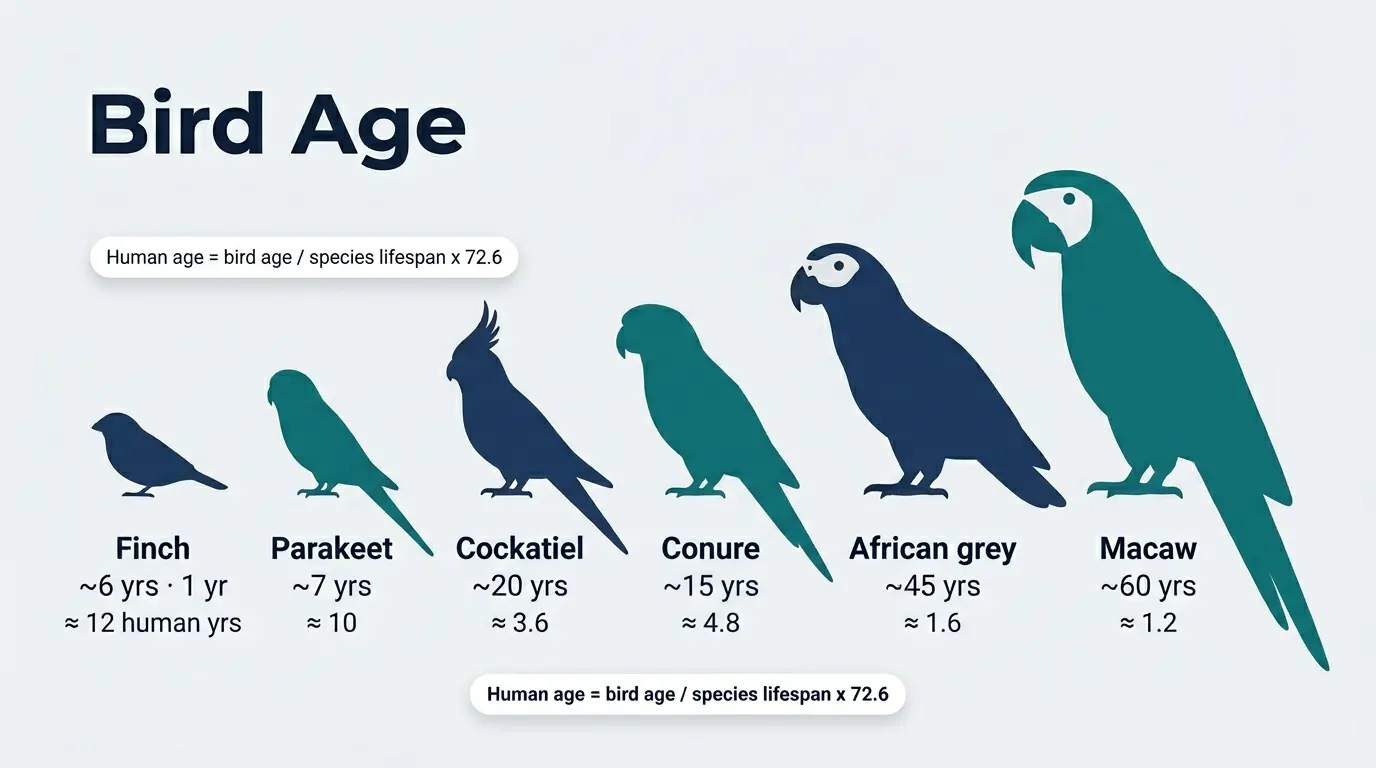
How Bird-to-Human Age Conversion Works
The conversion uses a proportional lifespan model. Since a parakeet lives ~7 years while humans average 72.6 years, each parakeet year equals roughly 10 human years. Larger parrots like macaws can live 60+ years, so their aging rate is much closer to ours. The formula takes the bird's current age as a fraction of its species' average lifespan, then multiplies by the 72.6-year human baseline.
- Small birds (finches, parakeets):
1 bird year ≈ 8–12 human years
- Medium birds (cockatiels, conures):
1 bird year ≈ 3–5 human years
- Large parrots (macaws, cockatoos):
1 bird year ≈ 1–1.5 human years
- Human life-expectancy baseline:
72.6 years (WHO global average)
Result also shows life stage and % of lifespan completed
Two birds the same age can have very different human-equivalent ages — species lifespan, not just age, is what drives the result.
Bird Species Lifespan & Aging-Rate Reference
Bird lifespans vary dramatically by species. According to ornithological longevity research, body size correlates strongly with longevity — larger species with slower metabolisms live far longer. The table shows average captive lifespans and how fast each species ages relative to humans.
| Species | Lifespan Range | Average | 1 Bird Year ≈ |
|---|---|---|---|
| Zebra Finch | 5–10 yrs | 6 yrs | 12 human yrs |
| Parakeet / Budgie | 5–10 yrs | 7 yrs | 10 human yrs |
| Canary | 8–12 yrs | 10 yrs | 7 human yrs |
| Lovebird | 10–20 yrs | 15 yrs | 5 human yrs |
| Cockatiel | 16–25 yrs | 20 yrs | 3.6 human yrs |
| Conure | 10–30 yrs | 15 yrs | 5 human yrs |
| Amazon Parrot | 30–50 yrs | 40 yrs | 1.8 human yrs |
| African Grey | 40–60 yrs | 45 yrs | 1.6 human yrs |
| Cockatoo | 40–70 yrs | 50 yrs | 1.5 human yrs |
| Macaw | 50–80 yrs | 60 yrs | 1.2 human yrs |
These are captive averages with good care. Wild birds typically live much shorter lives due to predation, disease, and food scarcity.
Understanding Bird Life Stages
Birds move through life stages much like humans, and knowing the stage helps you tailor diet, enrichment, and veterinary care. Small species like parakeets reach maturity within 6 months, while large parrots may not fully mature until age 4–5.
| Life Stage | % of Lifespan | What It Means |
|---|---|---|
| Baby / Juvenile | 0% to maturity | Bonding, socialization, weaning |
| Young Adult | Maturity–30% | High energy, training, breeding age |
| Adult | 30%–60% | Peak health and stability |
| Mature Adult | 60%–80% | Monitor weight and activity |
| Senior | 80%+ | Vet checks, softer perches, diet tweaks |
Birds past ~80% of their expected lifespan are considered seniors and benefit from more frequent health checkups.
Why Birds Age at Different Rates
The single biggest predictor of how long a bird lives — and therefore how fast it ages in human terms — is body size. Larger birds have slower metabolic rates, lower oxidative stress, and more efficient cellular repair, which lets them live for decades.
- Body size:
bigger species almost always live longer
- Metabolic rate:
slower metabolism means slower aging
- Captivity:
protection from predators and steady food extends life
- Diet quality:
pellet-based diets outlast all-seed diets
- Genetics and species:
parrots are among the longest-lived birds
How to Estimate an Unknown Bird's Age
Rescued or rehomed birds often come with no known age. While only a DNA test or a leg-band code gives certainty, several physical clues help you estimate age — which you can then plug into this calculator.
- Cere color (budgies):
changes with maturity and sex
- Iris color:
dark in many juveniles, lighter in adults
- Leg-band codes:
hatch year is often encoded
- Beak and feet:
smoother in young birds, rougher with age
- Feather quality and behavior:
maturity brings stable plumage
An avian veterinarian can give the most reliable age estimate and is worth a visit for any newly adopted bird.
Signs Your Bird Is Getting Older
Senior birds often hide illness, so subtle changes matter. Watch for these signs as your bird approaches the senior stage and adjust care accordingly.
Reduced activity, flying, or climbing
Cataracts or cloudiness in the eyes
Stiff joints or favoring one foot
Duller or slower-to-replace feathers
Changes in appetite, weight, or droppings
Any sudden change in a bird's behavior or appearance warrants a prompt avian-vet visit — birds mask illness until it is advanced.
Age-Appropriate Bird Care
Knowing your bird's human-equivalent age helps you match care to life stage. Young birds need socialization and training; adults need mental stimulation and a balanced diet; seniors need extra veterinary attention and easier access to food, water, and perches.
- Juveniles:
focus on bonding, socialization, and basic training
- Young adults:
mental enrichment, foraging toys, flight exercise
- Adults:
balanced pellet diet and an annual vet checkup
- Seniors:
bi-annual vet visits, softer perches, easy-reach food/water
Swap high perches for lower, wider ones as your bird ages to reduce strain and prevent falls.
Accuracy and Limitations
This calculator gives a useful estimate, not a medical measurement. Real aging depends on genetics, diet, housing, and individual health, and published lifespans are averages rather than guarantees. Use the result as a guide to anticipate care needs, and rely on your veterinarian for health decisions.
Exceptional individuals far exceed averages — some parrots live 20–30% longer than their species' typical lifespan with excellent care.
Quick Reference Card
Bird Age — Quick Reference
Quick reference • Bird Age Calculator
Human age = (bird age ÷ species lifespan) × 72.6Valid range: Bird age 0–100 yrs; 10 common species supported
Common Values
⚠ Watch Out
- •Results are estimates — individual birds vary with genetics, diet, and care
- •Lifespans are captive averages; wild birds usually live shorter lives
- •For unknown-age rescue birds, have an avian vet estimate the age first
Pro Tips
- →Larger species age slower — don't assume every bird ages like a budgie
- →Recheck your bird's human age yearly to anticipate senior-care needs
- →Compare pets with the cat and dog age calculators
FAQs
How do I calculate my bird's age in human years?
Divide your bird's age by its species' average lifespan, then multiply by the human life expectancy of 72.6 years. For example, a 5-year-old parakeet (avg lifespan 7 years): 5 ÷ 7 × 72.6 = 51.9 human years.
Do all birds age at the same rate?
No. Small birds like finches and parakeets age much faster relative to humans (1 year ≈ 10 human years), while large parrots like macaws age almost at the same rate as humans (1 year ≈ 1.2 human years). Body size and metabolic rate are the primary factors.
How can I tell how old my bird is?
For young birds, look at iris color (dark in juveniles, lighter in adults for many species), cere color in budgies, and leg-band codes if banded. For older birds, feather condition, beak texture, and behavioral changes can indicate aging. An avian veterinarian can provide the most accurate estimate.
What is the oldest bird ever recorded?
Cookie, a Major Mitchell's cockatoo at Brookfield Zoo in Chicago, lived to 83 (1933–2016). In the wild, albatrosses have been documented living past 70. These records show that with excellent care, large parrots can outlive their human companions.
Why do larger birds live longer?
Larger birds generally have slower metabolic rates, lower cellular oxidative stress, and more efficient DNA-repair mechanisms. This mirrors the pattern in mammals, where larger species with slower life histories tend to reach greater maximum lifespans.
How long do pet parrots live?
It varies widely by species: budgies average about 7 years, cockatiels around 20, African greys 40–60, and macaws 50–80 years. With a balanced diet, mental enrichment, and routine avian-vet care, many parrots reach the upper end of their range.
When is my bird considered a senior?
A bird is generally considered senior once it passes about 80% of its species' average lifespan. For a parakeet that's roughly age 5–6, while for a macaw it may be 48 or older. Senior birds benefit from more frequent checkups and small habitat adjustments.
Do wild birds live as long as pet birds?
Usually not. The lifespans used here are captive averages; wild birds of the same species typically live shorter lives because of predation, disease, weather, and food scarcity. Protection and steady nutrition are why pet birds often reach their full genetic potential.
Can I help my bird live longer?
Yes. A varied pellet-based diet, daily mental and physical enrichment, clean housing, avoidance of airborne toxins (like non-stick fumes), and regular avian-vet checkups all meaningfully extend a pet bird's healthy lifespan.