Last updated: May 30, 2026
Cat BMI Calculator

Creators
Dharmendra SinghReviewers
Creators
Dharmendra SinghReviewers
Quick Answer
Cats are not assessed with human BMI; vets use a 9-point Body Condition Score (BCS) based on rib palpation, waist visibility from above, and abdominal tuck. This calculator maps two 1–5 owner observations onto the standard scale using BCS = clamp(round(ribCoverage + waistView − 1), 1, 9). A BCS of 4–5 is ideal, 6–7 overweight, and 8–9 obese, with each point above 5 representing about 10–15% over ideal weight. About 60% of US cats are overweight, increasing diabetes risk up to fourfold, and safe weight loss is only 1–2% per week to avoid hepatic lipidosis.
Cats are not assessed with human BMI; vets use a 9-point Body Condition Score from 1, emaciated, to 9, morbidly obese. A score of 4 or 5 is ideal, with ribs easily felt and a waist visible from above.
Key Takeaways
- Cats are scored on a 9-point Body Condition Score (BCS), not human-style BMI.
- Formula here: BCS = clamp(round(ribCoverage + waistView − 1), 1, 9).
- BCS 4–5 is ideal; 6–7 overweight; 8–9 obese — each unit ≈ 10–15% over ideal weight.
- About 60% of US cats are overweight or obese, raising diabetes risk up to 4×.
- Safe weight loss is only 1–2% per week — faster can cause fatal hepatic lipidosis.
Creators
Dharmendra SinghReviewers
Creators
Dharmendra SinghReviewers
Formula
BCS = (Weight / Ideal Weight) × 5
Where:
- BCS=Body Condition Score((1-9 scale))
- W_{actual}=Actual Weight(kg)
- W_{ideal}=Ideal Weight for breed/frame(kg)
Worked Examples
Healthy Indoor Cat
A 4.5 kg domestic shorthair with ribs felt with slight pressure and a slight visible waist.
- 1Cat weight: 4.5 kg
- 2Rib coverage: 3 (felt with slight pressure)
- 3Waist visibility: 3 (slight waist)
- 4BCS = clamp(round(3 + 3 − 1), 1, 9) = 5 → Ideal
Overweight Persian Cat
A 7.2 kg Persian with ribs difficult to feel and no visible waist.
- 1Cat weight: 7.2 kg
- 2Rib coverage: 4 (difficult to feel)
- 3Waist visibility: 4 (no waist)
- 4BCS = clamp(round(4 + 4 − 1), 1, 9) = 7 → Overweight
- 5Ideal weight ≈ 7.2 × 5 ÷ 7 ≈ 5.1 kg (range 4.6 – 5.7 kg)
Underweight Senior Cat
A 2.8 kg senior cat with clearly visible ribs and a severe abdominal tuck — needs a vet check.
- 1Cat weight: 2.8 kg
- 2Rib coverage: 1 (ribs clearly visible)
- 3Waist visibility: 1 (severe tuck)
- 4BCS = clamp(round(1 + 1 − 1), 1, 9) = 1 → Underweight
Introduction
The Cat BMI Calculator uses the veterinary Body Condition Score (BCS) system — the gold-standard 9-point scale endorsed by the WSAVA Global Nutrition Committee and AAHA — to assess your cat's weight status. Unlike human BMI which uses height and weight, cats are evaluated on physical observations: rib palpation, waist visibility from above, and abdominal tuck from the side. Enter your cat's weight plus two simple 1–5 observations and the calculator returns a BCS, weight category, an estimated ideal-weight range, and a tailored recommendation. The Association for Pet Obesity Prevention reports that about 60% of cats in the United States are overweight or obese, making this assessment a critical health screen. For related feline tools, see our cat calorie calculator, cat age calculator, and cat quality of life calculator.
Why Cats Don't Have a Real BMI
Human BMI uses height and weight to estimate body fat — but you can't easily measure a cat's height, and the relationship between weight and fat varies wildly between breeds. A 5 kg Maine Coon kitten can be lean while a 5 kg Singapura is dangerously obese. That's why veterinarians use the Body Condition Score (BCS), a 9-point visual-and-tactile scale that assesses body fat directly through palpation and observation.
BCS is breed-independent — works for Maine Coons and Singapuras alike
Combines palpation (feel) and inspection (look) for accuracy
Validated against DEXA body-fat scans in peer-reviewed studies
Used in every modern small-animal veterinary practice
Re-score your cat every month — small changes are easier to catch on the BCS scale than on a bathroom scale.
Understanding the 9-Point Body Condition Score
The Body Condition Score (BCS) is a 9-point scale developed by veterinary nutritionists and widely adopted by AAHA and WSAVA. Higher scores mean more body fat. A score of 4–5 is ideal; each point above 5 represents roughly 10–15% over ideal weight.
- BCS 1–3:
Underweight — ribs, spine, and hip bones clearly visible; minimal body fat; possible muscle wasting
- BCS 4–5:
Ideal — ribs easily felt with minimal fat covering; visible waist from above; slight abdominal tuck
- BCS 6–7:
Overweight — ribs palpable with moderate fat; waist barely visible; rounded abdomen
- BCS 8–9:
Obese — ribs cannot be felt under thick fat; no waist; pendulous belly; fat deposits on limbs
A single BCS unit ≈ 10–15% of body weight. A cat at BCS 7 is roughly 20–30% over ideal weight.
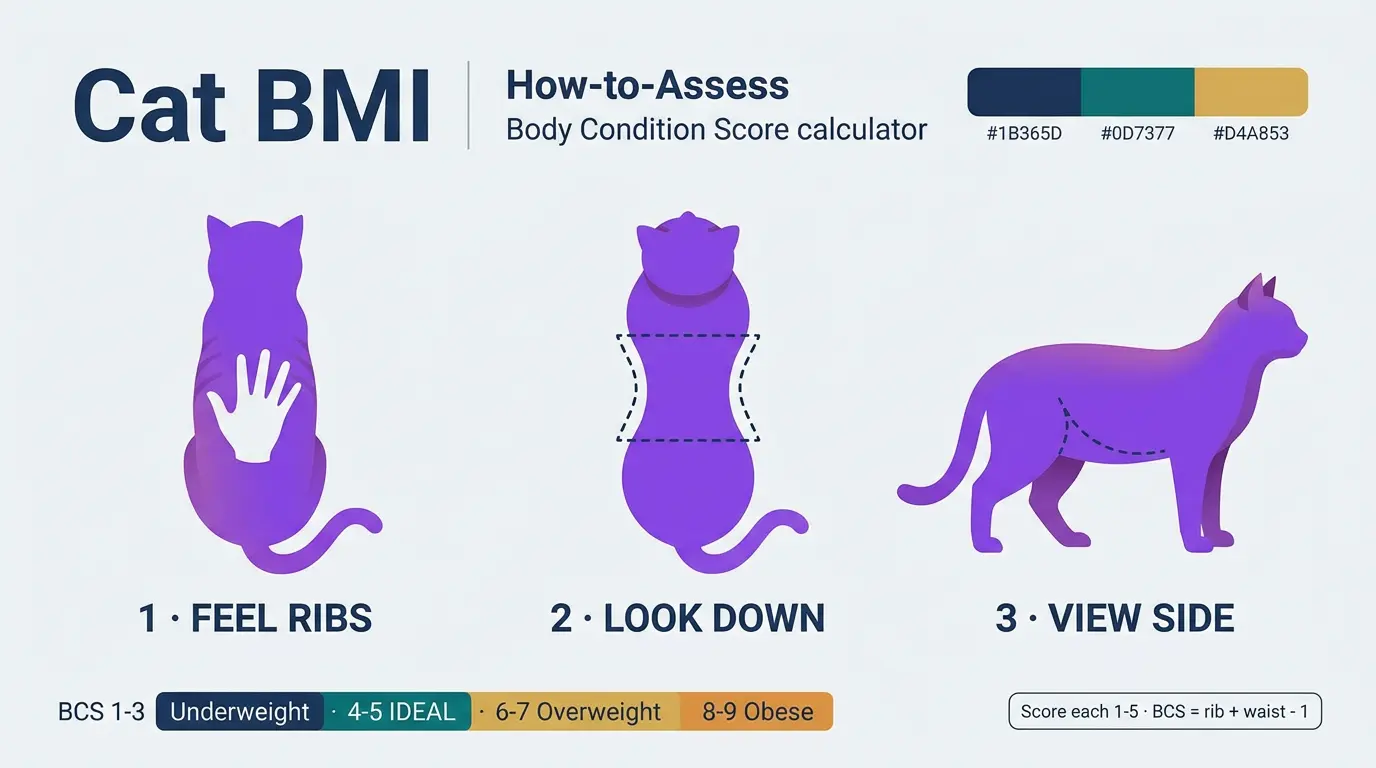
How to Body-Score Your Cat at Home
Spend a minute on three quick checks — they take less than a minute and give a reliable score.
- Feel the ribs:
run flat fingers across the side of the chest behind the front legs. You should feel individual ribs through a thin layer (ideal). If they feel like the back of your hand, BCS 4–5; like your knuckles, underweight; like your palm, overweight.
- Look down from above:
stand over a standing cat. An hourglass narrowing behind the ribs is ideal. Straight sides = overweight; bulging beyond the ribs = obese.
- View from the side:
at standing height, the belly should tuck up slightly from the rib cage toward the back legs. A flat line = overweight; a sagging belly = obese.
Use this calculator's two 1–5 sliders to convert your assessment into a BCS
Long-haired cats are deceptive — palpation matters far more than the visual outline. Always feel before scoring.
Ideal Weight Ranges by Breed
Cat breeds vary dramatically in ideal adult weight. Using a single weight standard for all cats would be like expecting a Chihuahua and a Great Dane to weigh the same. The BCS system accounts for this by evaluating body composition rather than absolute weight.
| Breed | Ideal Weight (kg) | Ideal Weight (lb) |
|---|---|---|
| Singapura | 1.8–3.6 | 4–8 |
| Siamese | 3.5–5.5 | 8–12 |
| Domestic Shorthair | 3.6–5.4 | 8–12 |
| Persian | 3.2–5.4 | 7–12 |
| British Shorthair | 4.0–7.7 | 9–17 |
| Bengal | 3.6–6.8 | 8–15 |
| Norwegian Forest Cat | 4.0–7.5 | 9–16 |
| Ragdoll | 4.5–9.1 | 10–20 |
| Maine Coon | 5.4–8.2 | 12–18 |
These ranges are for healthy adult cats at BCS 4–5. Older cats may sit at the lower end of the range as muscle mass declines.
Health Risks of an Overweight Cat
Feline obesity is associated with significantly increased risk of several serious conditions. Studies show that overweight cats have 2–4× higher risk of diabetes mellitus and a 1.5× higher risk of lower urinary tract disease than cats at ideal weight.
Type 2 diabetes mellitus — overweight cats are up to 4× more likely to develop diabetes than lean cats
Hepatic lipidosis (fatty liver) — can develop in as little as 2–3 days of not eating in obese cats
Osteoarthritis — excess weight accelerates joint degeneration, especially in older cats
Shortened lifespan — overweight cats live an average of 2–3 years less than ideal-weight cats
Skin and coat problems — obese cats cannot groom properly, leading to matted fur and skin infections
Lower urinary tract disease — overweight cats have ~50% higher risk of FLUTD
Cat Weight-Management Plan
If your cat's BCS indicates overweight (6–7) or obese (8–9), a structured plan is essential. Veterinarians recommend a weight loss rate of 1–2% of body weight per week — too rapid weight loss in cats can trigger life-threatening hepatic lipidosis.
Set a target weight based on BCS and ideal-weight range (e.g., target the midpoint of the breed range)
Calculate daily calorie needs: RER = 70 × (target weight in kg)^0.75, then feed 80% of that for weight loss
Feed for the TARGET weight, not current weight — typically a 15–25% calorie reduction
Switch to a high-protein, low-carbohydrate diet — cats are obligate carnivores
Add 15–20 min of daily play (wand toys, laser pointers, food puzzles)
Weigh weekly at the same time and adjust food portions every 2 weeks based on progress
Eliminate free-feeding — use measured meals 2–3 times daily
Use a kitchen scale, not a measuring cup. The difference between ⅓ cup and ½ cup can be 30+ calories — enough to cause 0.5 kg of weight gain per year for a sedentary indoor cat.
Underweight Cats — When to Worry
A cat at BCS 1–3 is just as much a red flag as one at BCS 8–9. Unintended weight loss in cats often signals a treatable underlying disease, and waiting too long can be dangerous.
Hyperthyroidism — common in cats over 10, causes weight loss despite a big appetite
Chronic kidney disease — third-most-common cause of feline weight loss
Diabetes mellitus — can cause weight loss especially in older or undiagnosed cats
Dental disease — painful teeth quietly reduce food intake
Intestinal disease or parasites — IBD, lymphoma, worms
Cancer — unexplained weight loss in an older cat warrants a thorough work-up
Any unintentional weight loss greater than 5% in a few weeks warrants a vet visit, even if your cat seems otherwise normal.
When to See a Veterinarian
This calculator is a useful home screen, but certain situations need professional evaluation. Sudden weight changes can indicate underlying medical conditions that need diagnosis and treatment.
Sudden weight loss (>2% per week) without dietary changes — possible hyperthyroidism, diabetes, kidney disease, or cancer
BCS 1–2 (severely underweight) — needs prompt medical evaluation
BCS 9 (morbidly obese) — requires a supervised weight-loss program to prevent liver disease
Weight gain despite controlled feeding — possible hypothyroidism (rare in cats) or fluid retention
Changes in appetite, thirst, or litter-box habits alongside weight changes
This calculator is an educational screen and does not replace professional veterinary assessment. Always consult your veterinarian before starting a weight-management program.
Quick Reference Card
Cat Body Condition Score — Quick Reference
Quick reference • Cat BMI Calculator
BCS = clamp(round(ribCoverage + waistView − 1), 1, 9)Valid range: Each observation 1–5; BCS 1 (emaciated) – 9 (morbidly obese)
Common Values
⚠ Watch Out
- •Never crash-diet a cat — hepatic lipidosis can develop in 2–3 days of fasting
- •Long-haired cats need palpation, not just a visual outline
- •Unintended weight loss >5% needs a vet visit, not just a feeding change
- •Kittens use growth curves instead of BCS
Pro Tips
- →Weigh weekly at the same time on a kitchen-style baby scale
- →Feed for the target weight, not the current weight (≈ 80% of RER)
- →Use puzzle feeders to slow eating and add mental stimulation
- →High-protein, low-carbohydrate food works best for feline weight loss
FAQs
What is a healthy weight for a cat?
A healthy weight depends on breed, frame size, and age. Most domestic cats sit between 3.5 and 5.5 kg (8–12 lb), but larger breeds like Maine Coons can healthily weigh up to 8–9 kg. The 9-point Body Condition Score (BCS) is more reliable than weight alone — aim for BCS 4–5.
Do cats actually have a BMI?
Not in the human sense. Cats are evaluated using a 9-point Body Condition Score (BCS) instead of BMI. The BCS uses rib palpation, waist visibility from above, and abdominal tuck — observations that are far more accurate than weight or any body-mass index would be for cats.
How do I check my cat's body condition score at home?
Three quick checks: feel the ribs along the chest (you should feel individual ribs through a thin fat layer), look down from above (an hourglass shape behind the ribs is ideal), and view from the side (the belly should tuck up slightly toward the back legs). Score each observation 1–5 and enter the values above.
Is my indoor cat more likely to be overweight?
Yes. Indoor cats have fewer chances to exercise and often eat out of boredom. Studies show roughly 40% of indoor-only cats are overweight versus 25% of cats with outdoor access. Measured meals, daily play, and puzzle feeders help close that gap.
How much should I feed my overweight cat?
Calculate resting energy requirement (RER) using 70 × (target weight in kg)^0.75. For weight loss, feed about 80% of that RER for the target weight. For a cat targeting 4.5 kg, this is roughly 180–200 calories per day. Always confirm with your vet for cats with chronic conditions.
Can cats get diabetes from being overweight?
Yes. Overweight cats are up to 4 times more likely to develop type 2 diabetes mellitus. The good news is that feline diabetes can sometimes be reversed with weight loss and dietary management — unlike in humans, where it is usually progressive.
How quickly should my cat lose weight?
Cats should lose no more than 1–2% of body weight per week (about 50–100 g for a 5 kg cat). Rapid weight loss (>2% per week) can trigger hepatic lipidosis — a potentially fatal fatty-liver disease that is largely unique to cats.
Does the BCS work for kittens?
No — kittens are still growing and have different body composition. The 9-point BCS is validated for adult cats (12+ months). For kittens, your vet will assess growth curves and rib palpation as part of routine wellness checks.
Why does my long-haired cat look heavier than it is?
Long fur can hide both excess body fat and a healthy waistline. Always rely on hands-on palpation rather than the visual outline for long-haired breeds like Maine Coons, Persians, and Norwegian Forest Cats. Felt ribs through a thin fat layer is the key sign of an ideal BCS.
What if my cat's BCS keeps creeping up?
Re-evaluate calorie intake first — small overfeeding adds up fast. Switch to measured meals, eliminate treats or count them toward the daily allowance, and add play time. If your cat is gaining weight on a controlled diet, a vet visit can rule out fluid retention or a rare endocrine issue.
What's the difference between BCS and Muscle Condition Score (MCS)?
BCS measures body fat; MCS — also from WSAVA — separately scores muscle mass on a 1–4 scale (normal, mild, moderate, severe muscle loss). Older cats can be overweight (high BCS) and yet have muscle loss (low MCS) at the same time, so vets check both.