Last updated: June 19, 2026
Cell Doubling Time Calculator

Creators
Dharmendra SinghReviewers
Creators
Dharmendra SinghReviewers
Quick Answer
The Cell Doubling Time Calculator finds how long a cell population takes to double during exponential growth using t_d = t × ln(2) / ln(Nₜ/N₀), where t is the elapsed time and N₀ and Nₜ are the initial and final concentrations (cell counts, CFU/mL, or OD₆₀₀). It also returns the specific growth rate μ = ln(Nₜ/N₀)/t (h⁻¹) and the number of generations log₂(Nₜ/N₀). For example, an 8-fold increase over 3 hours gives a 1.0-hour doubling time and 3 generations. Doubling times range from about 20 minutes for E. coli to 24 hours or more for mammalian cells.
Cell doubling time equals the elapsed time multiplied by the natural log of 2, divided by the natural log of the final concentration divided by the initial concentration. An eight-fold increase over three hours gives a doubling time of one hour.
Key Takeaways
- Doubling time is computed as t_d = t × ln(2) / ln(Nₜ/N₀), where N₀ and Nₜ are the initial and final concentrations
- The specific growth rate μ = ln(Nₜ/N₀) / t (h⁻¹) is the inverse driver of doubling time: t_d = ln(2)/μ
- Generations (doublings) = log₂(Nₜ/N₀) — an 8-fold increase equals 3 generations
- Measurements must be taken during exponential (log) phase — lag or stationary points give wrong results
- Inputs can be cell counts, CFU/mL, or OD₆₀₀ readings because the formula uses their ratio
- Doubling time ranges from ~20 min (E. coli) to 24+ hours (mammalian cells), depending on conditions
Creators
Dharmendra SinghReviewers
Creators
Dharmendra SinghReviewers
Formula
Doubling Time = Duration × ln(2) / ln(Final/Initial)
Where:
- t_d=Doubling time(hours)
- t=Elapsed time(hours)
- N_0=Initial cell concentration(cells/mL)
- N_t=Final cell concentration(cells/mL)
- ln=Natural logarithm
Worked Examples
E. coli growth in rich media
A bacterial culture grows 8-fold (1×10⁵ → 8×10⁵ cells/mL) over 3 hours of log-phase growth.
- 1Growth ratio = 800000 / 100000 = 8
- 2ln(8) = 2.079
- 3Specific growth rate μ = 2.079 / 3 = 0.693 h⁻¹
- 4Doubling time = 3 × ln(2) / ln(8) = 3 × 0.693 / 2.079 = 1.0 hour
- 5Generations = ln(8) / ln(2) = 3 doublings
HeLa cell culture over two days
A mammalian cell line quadruples (5×10⁴ → 2×10⁵ cells/mL) over a 48-hour growth window.
- 1Growth ratio = 200000 / 50000 = 4
- 2ln(4) = 1.386
- 3Doubling time = 48 × 0.693 / 1.386 = 24 hours
- 4Generations = ln(4) / ln(2) = 2 doublings
Yeast (S. cerevisiae) by OD₆₀₀
An optical-density reading is used instead of a cell count: OD₆₀₀ rises from 0.1 to 0.8 in 4.5 hours.
- 1Growth ratio = 0.8 / 0.1 = 8 (OD₆₀₀ is proportional to cell mass)
- 2ln(8) = 2.079
- 3Doubling time = 4.5 × 0.693 / 2.079 = 1.5 hours (90 min)
- 4Generations = ln(8) / ln(2) = 3 doublings
Introduction
The Cell Doubling Time Calculator computes the time required for a cell population to double in number during exponential growth. It is a fundamental parameter in cell biology, microbiology, and biotechnology. From two measurements taken during log-phase growth it returns the doubling time, the specific growth rate (μ), and the number of generations — using the relationship t_d = t × ln(2) / ln(Nₜ/N₀). Doubling time is used to characterise bacterial growth, optimise cell culture conditions, screen anti-proliferative drugs, and monitor culture health. Pair this tool with our cell dilution calculator and DNA concentration calculator for a complete lab workflow.
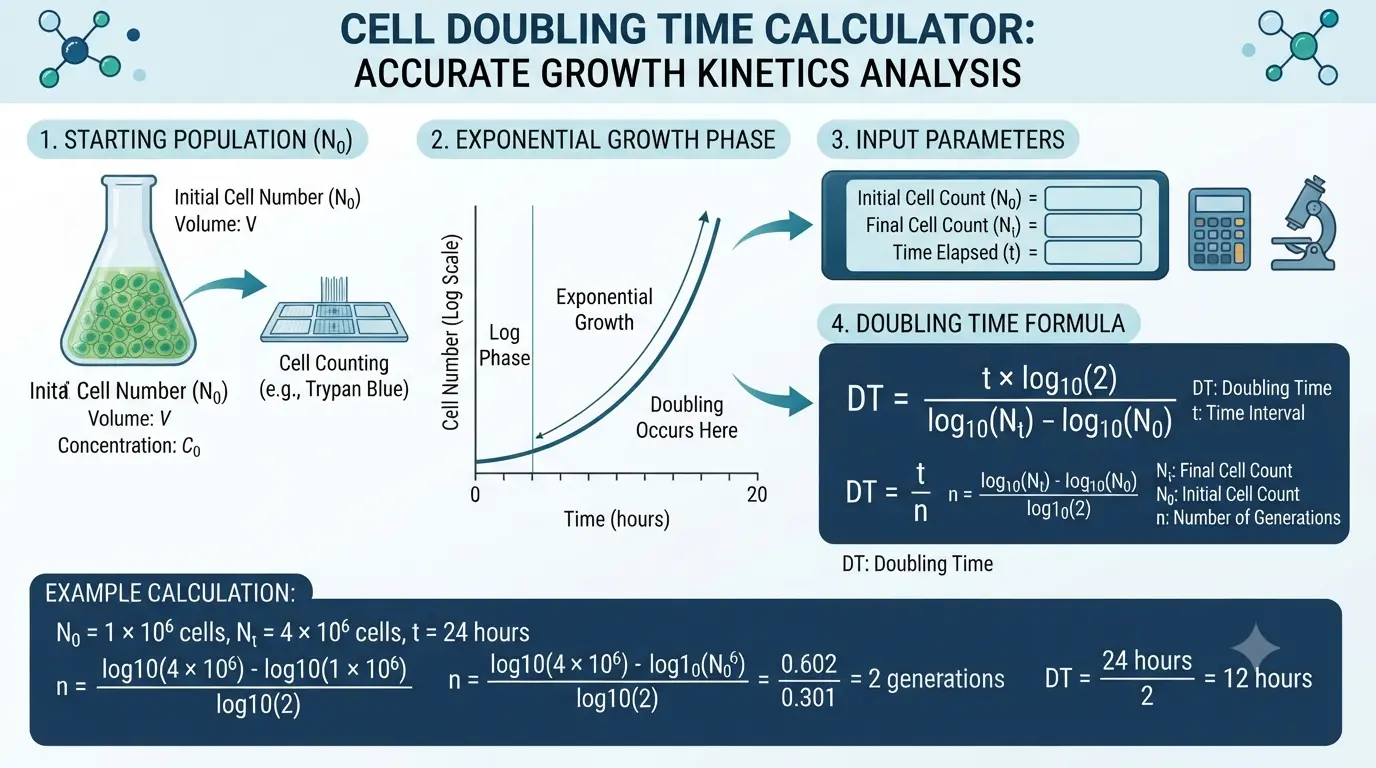
How Cell Doubling Time Is Calculated
During exponential growth a cell population increases at a rate proportional to its current size, so it doubles at a constant interval. From any two points in log phase, the specific growth rate is μ = ln(Nₜ/N₀) / t, and the doubling time is t_d = ln(2) / μ = t × ln(2) / ln(Nₜ/N₀). This kinetic framework was established by Monod (1949) in foundational studies of bacterial growth.
ln(2) ≈ 0.693 — the natural logarithm of 2, a constant in every doubling calculation
Specific growth rate μ = ln(Nₜ/N₀) / t (units: h⁻¹) — the instantaneous fractional growth rate
Doubling time t_d = ln(2) / μ — inversely proportional to growth rate
Generations (doublings) = ln(Nₜ/N₀) / ln(2) = log₂(Nₜ/N₀)
Both measurements must come from the exponential (log) phase, not lag or stationary phase
N₀ and Nₜ can be cell counts, CFU/mL, or OD₆₀₀ — any measure proportional to cell mass
How to Use This Calculator (Step by Step)
The calculator turns two routine measurements into growth kinetics. Follow these steps for a reliable result:
Measure the cell concentration (or OD₆₀₀) at the start of the log-phase window and enter it as the Initial Cell Concentration
Measure again later in log phase and enter it as the Final Cell Concentration (must be greater than the initial)
Enter the Time Elapsed between the two measurements, in hours
Read the Doubling Time (hours and minutes), the Specific Growth Rate μ, and the number of Generations
Compare your doubling time against the reference table below to confirm the culture is healthy
Pick two time points that are clearly within the straight-line portion of a semi-log growth plot. Measurements taken during lag or stationary phase will distort μ and the doubling time.
The Four Phases of Microbial Growth
A batch culture passes through four distinct phases. The doubling-time formula is only valid during the log (exponential) phase, when growth is balanced and the rate is constant.
| Phase | What happens | Doubling-time formula valid? |
|---|---|---|
| Lag | Cells adapt to the medium; little or no division | No — growth is not exponential |
| Log (exponential) | Constant maximum growth rate; population doubles at a fixed interval | Yes — measure here |
| Stationary | Nutrients deplete; growth balances death; numbers plateau | No — net growth ≈ 0 |
| Death (decline) | Death exceeds division; viable count falls | No — population is shrinking |
If your calculated doubling time looks implausibly long or short, the most common cause is sampling outside log phase. Re-sample two points that fall on the straight section of a semi-log plot.
Typical Cell Doubling Times by Organism
Doubling times vary enormously across organisms. Use the table below to sanity-check your result — values are drawn from standard microbiological references.
| Organism / Cell Type | Doubling Time | Conditions |
|---|---|---|
| E. coli (optimal) | 20 min | 37°C, rich media (LB) |
| E. coli (minimal media) | 60 min | 37°C, M9 glucose |
| Bacillus subtilis | 25–30 min | 37°C, LB broth |
| Saccharomyces cerevisiae | 90 min | 30°C, YPD |
| CHO cells | 12–24 hours | 37°C, F-12 media |
| HeLa cells | ~24 hours | 37°C, DMEM + 10% FBS |
| Primary fibroblasts | 24–48 hours | 37°C, DMEM |
| Human stem cells (iPSC) | 36–48 hours | 37°C, mTeSR1 |
| Mycobacterium tuberculosis | 15–20 hours | 37°C, 7H9 media |
Using OD₆₀₀ Instead of Cell Counts
For bacteria and yeast, optical density at 600 nm (OD₆₀₀) is the fastest way to track growth. Because the doubling-time formula uses a ratio of two measurements, any quantity proportional to cell mass works — the units cancel.
Enter OD₆₀₀ readings directly as the initial and final values — no conversion needed
Keep OD₆₀₀ below ~0.8–1.0; above this the relationship between OD and cell number becomes non-linear
Dilute dense samples back into the linear range and multiply by the dilution factor before recording
Always blank the spectrophotometer with sterile medium
OD measures total (live + dead) mass; for viable-cell doubling time, use CFU counts or a viability assay
Growth Rate, Doubling Time, and Generations
These three outputs describe the same growth from different angles. Understanding how they relate helps you report results correctly in a paper or lab notebook.
- Specific growth rate μ (h⁻¹):
the fraction by which the population grows per unit time — higher μ means faster growth
- Doubling time t_d = ln(2)/μ:
the time for one doubling — lower t_d means faster growth (inverse of μ)
- Generations n = log₂(Nₜ/N₀):
how many times the population doubled over the whole interval
- Relationship:
Nₜ = N₀ × 2ⁿ = N₀ × e^(μt) — exponential growth expressed two equivalent ways
Average generation time = total time / number of generations = t / n, which equals t_d during steady log phase
Applications in Research and Biotechnology
Cell doubling time is measured across research and industry — it is one of the most-reported numbers in a growth experiment.
- Antibiotic testing:
MIC and time-kill assays measure how drugs lengthen bacterial doubling time
- Cancer research:
quantifying how candidate compounds slow tumour-cell proliferation
- Bioprocessing:
keeping cells in log phase to maximise yield in fermenters and bioreactors
- Quality control:
a stable doubling time signals a healthy, uncontaminated culture — pair with our cell dilution calculator when seeding
- Strain engineering & evolution:
comparing fitness between wild-type and mutant strains
- Toxicology:
detecting growth inhibition from environmental or chemical stressors
Common Mistakes to Avoid
Most inaccurate doubling times trace back to a handful of avoidable errors:
- Sampling outside log phase:
lag or stationary-phase points break the exponential assumption
- Using OD₆₀₀ above the linear range:
readings over ~1.0 underestimate true cell number and inflate t_d
- Final ≤ initial:
the formula requires net growth; equal or declining values cannot define a doubling time
Mismatched units between the two measurements: both must be the same quantity (both counts, or both OD)
- Too short an interval:
if the change is barely above measurement noise, μ is unreliable — span at least one doubling
- Forgetting temperature/medium effects:
a result is only comparable under identical conditions
Troubleshooting Growth Measurements
If your doubling time does not match expectations, use this table to find the likely cause.
| Symptom | Likely cause | Fix |
|---|---|---|
| Doubling time far too long | One or both points outside log phase | Re-sample on the straight part of a semi-log plot |
| Result is zero / undefined | Final ≤ initial (no net growth) | Ensure the second reading is taken later in log phase |
| Inconsistent between replicates | OD readings above linear range | Dilute to OD < 0.8 and apply the dilution factor |
| μ higher than expected | Interval too short, dominated by noise | Span a longer interval (≥ one doubling) |
| Doubling time drifts over time | Culture entering stationary phase | Use earlier time points or sub-culture into fresh media |
Cell Growth Glossary
Key terms used in growth kinetics. Understanding these will help you interpret the calculator's outputs and your protocols:
| Term | Definition |
|---|---|
| Doubling time (t_d) | The time for a population to double in number during exponential growth. |
| Specific growth rate (μ) | The instantaneous fractional increase in population per unit time, ln(Nₜ/N₀)/t (h⁻¹). |
| Generation | One complete doubling of the population; generations = log₂(Nₜ/N₀). |
| Log (exponential) phase | The growth phase where the rate is maximal and constant — the only valid window for this formula. |
| Lag phase | The initial adaptation period before exponential growth begins. |
| Stationary phase | The plateau where division balances death and net growth is near zero. |
| OD₆₀₀ | Optical density at 600 nm, a fast proxy for cell mass in bacterial and yeast cultures. |
| CFU/mL | Colony-forming units per millilitre — a count of viable, culturable cells. |
Quick Reference Card
Cell Doubling Time — Quick Reference
Quick reference • Cell Doubling Time Calculator
t_d = t · ln2 / ln(Nₜ/N₀) • μ = ln(Nₜ/N₀)/t • generations = log₂(Nₜ/N₀)Valid range: Requires net growth: Final > Initial, measured in log phase
Common Values
⚠ Watch Out
- •Only valid in exponential (log) phase — avoid lag and stationary-phase points
- •Final must exceed initial; equal or declining values cannot define a doubling time
- •Keep OD₆₀₀ below ~0.8–1.0 to stay in the linear range
- •Use the same measurement type (both counts or both OD) for initial and final
Pro Tips
- →Sample two points on the straight part of a semi-log plot for the most accurate μ
- →Span at least one full doubling so the change rises clearly above measurement noise
- →Report μ, t_d, and generations together — they describe the same growth three ways
- →Compare doubling times only across cultures grown at the same temperature and medium
FAQs
What is cell doubling time?
Cell doubling time is the time required for a cell population to double in number during the exponential growth phase. It is the reciprocal of the specific growth rate (t_d = ln 2 / μ) and ranges from about 20 minutes for fast-growing bacteria like E. coli to 24 hours or more for mammalian cells.
How do you calculate doubling time?
Use the formula Doubling Time = t × ln
- 1/ ln(Nₜ / N₀), where t is the elapsed time and N₀ and Nₜ are the initial and final concentrations. For example, an 8-fold increase over 3 hours gives 3 × 0.693 / ln
- 2= 1.0 hour
Both values can be cell counts, CFU/mL, or OD₆₀₀ readings.
What is the specific growth rate (μ)?
The specific growth rate μ is the fractional increase in population per unit time, calculated as μ = ln(Nₜ/N₀) / t with units of h⁻¹. It is directly related to doubling time: t_d = ln(2) / μ ≈ 0.693 / μ. A higher μ means faster growth and a shorter doubling time.
Why must measurements be taken in exponential phase?
The doubling-time formula assumes a constant exponential growth rate. During lag phase cells are still adapting, and during stationary phase nutrient limitation halts net growth — in both, growth is not exponential, so the formula gives misleading results. Always sample two points on the straight portion of a semi-log growth plot.
Can I use OD600 instead of a cell count?
Yes. Because the formula uses the ratio Nₜ/N₀, any measure proportional to cell mass works and the units cancel. Enter OD₆₀₀ readings directly. Keep OD₆₀₀ below about 0.8–1.0, where it stays linear with cell number; dilute denser samples back into that range before reading.
What is a normal doubling time for HeLa cells?
HeLa cells typically double about every 24 hours under standard conditions (37°C, DMEM + 10% FBS, 5% CO₂). Values well outside the 18–30 hour range often indicate culture stress, over-confluence, or contamination.
How many generations occurred during my experiment?
The number of generations (doublings) equals log₂(Nₜ/N₀) = ln(Nₜ/N₀) / ln(2). For a 4-fold increase that is 2 generations; for an 8-fold increase, 3 generations. The calculator reports this as the 'Generations' output.
Why does the calculator return zero?
It returns zeros when the inputs cannot define a doubling time — typically when the final concentration is less than or equal to the initial concentration (no net growth), or when any input is zero, negative, or non-numeric. Make sure the second measurement is larger and taken later in log phase.
Does temperature affect doubling time?
Strongly. Growth rate rises with temperature up to an organism's optimum, then falls sharply. E. coli doubles in ~20 min at 37°C but much more slowly at room temperature. Nutrients, pH, oxygen, and medium composition also shift doubling time, so only compare values measured under identical conditions.