Last updated: June 19, 2026
DNA Concentration Calculator

Creators
Dharmendra SinghReviewers
Creators
Dharmendra SinghReviewers
Quick Answer
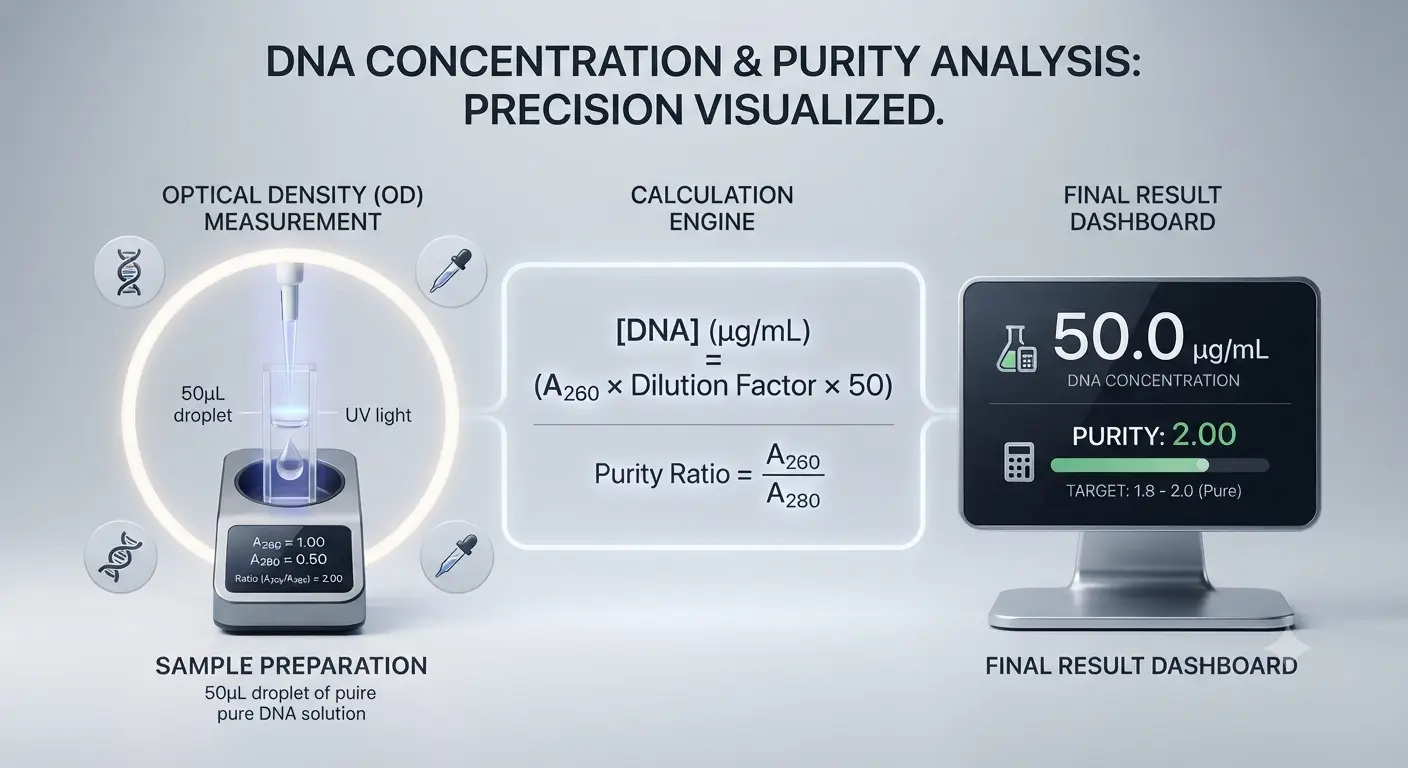
The DNA Concentration Calculator converts UV absorbance at 260 nm to DNA concentration using the Beer-Lambert law. For double-stranded DNA, multiply A₂₆₀ by 50 ng/µL per cm path length and the dilution factor. Pure DNA has an A260/A280 ratio of 1.8-2.0. This calculator supports dsDNA, ssDNA, and RNA with their respective extinction coefficients.
DNA concentration is calculated by multiplying the absorbance at 260 nanometers by 50 for double-stranded DNA, giving the result in nanograms per microliter. Pure DNA has an A260 to A280 ratio between 1.8 and 2.0.
Key Takeaways
- DNA concentration = A₂₆₀ × extinction coefficient × dilution factor (for 1 cm path length)
- Extinction coefficients: dsDNA = 50, ssDNA = 33, RNA = 40 (ng·cm/µL)
- A260/A280 ratio of 1.8-2.0 indicates pure DNA; below 1.7 = protein contamination
- Linear range for UV measurement: A₂₆₀ between 0.1-1.0 (standard) or 2-15,000 ng/µL (NanoDrop)
- For critical applications (NGS, qPCR standards), use fluorometric quantification (Qubit) instead
Creators
Dharmendra SinghReviewers
Creators
Dharmendra SinghReviewers
Formula
Concentration = A₂₆₀ × ε × Dilution Factor
Where:
- C=DNA Concentration(ng/µL or µg/mL)
- A_{260}=Absorbance at 260 nm(AU)
- \varepsilon=Extinction coefficient (50 for dsDNA, 33 for ssDNA, 40 for RNA)(ng·cm/µL)
- DF=Dilution Factor
Worked Examples
Standard Plasmid Prep
Measuring a miniprep DNA sample on NanoDrop.
- 1A₂₆₀ = 0.4 AU at 260 nm
- 2Nucleic acid type: dsDNA (ε = 50 ng·cm/µL)
- 3Dilution factor = 1 (undiluted)
- 4Path length = 0.1 cm (NanoDrop)
- 5Concentration = 0.4 × 50 × 1 / 0.1 = 200 ng/µL
- 6A260/A280 = 0.4/0.22 = 1.82 — Good purity (1.8-2.0 expected)
Genomic DNA from Blood
Measuring extracted genomic DNA from whole blood.
- 1A₂₆₀ = 0.15 (diluted 1:10 before reading)
- 2Concentration = 0.15 × 50 × 10 = 75 ng/µL (undiluted stock)
- 3A260/A280 = 0.15/0.078 = 1.92 — Pure DNA
Introduction
The DNA Concentration Calculator uses the Beer-Lambert law to convert UV spectrophotometry absorbance readings into nucleic acid concentrations. At 260 nm, the aromatic bases in DNA and RNA absorb UV light proportionally to their concentration, with known extinction coefficients: 50 ng·cm/µL for dsDNA, 33 for ssDNA, and 40 for RNA. The A260/A280 ratio provides a purity assessment — pure DNA should give a ratio of 1.8-2.0, while contamination with protein (absorbs at 280 nm) lowers this ratio.
Beer-Lambert Law in Molecular Biology
The Beer-Lambert law states that absorbance is directly proportional to the concentration of the absorbing species and the path length of light through the sample. For nucleic acids: A = ε × c × l, where A is absorbance, ε is the molar extinction coefficient, c is concentration, and l is path length. Rearranging gives concentration from absorbance.
- dsDNA:
1 A₂₆₀ unit = 50 µg/mL (or 50 ng/µL) at 1 cm path length
- ssDNA:
1 A₂₆₀ unit = 33 µg/mL — lower because fewer stacked bases
- RNA:
1 A₂₆₀ unit = 40 µg/mL — intermediate stacking interaction
- Linear range:
A₂₆₀ between 0.1 and 1.0 for standard spectrophotometers
- NanoDrop:
Uses 0.05-1 mm path length, automatically adjusts concentration
DNA Purity Assessment (A260/A280 and A260/A230)
The A260/A280 ratio is the primary indicator of nucleic acid purity. Proteins absorb strongly at 280 nm (due to tryptophan and tyrosine), so protein contamination decreases this ratio below 1.8.
- A260/A280 = 1.8-2.0:
Pure DNA — acceptable for most applications
- A260/A280 < 1.7:
Protein contamination — consider phenol:chloroform extraction or column purification
- A260/A280 > 2.1:
RNA contamination — treat with RNase A
- A260/A230 = 2.0-2.2:
Free of organic contaminants (phenol, TRIzol, guanidine)
- A260/A230 < 1.5:
Carryover contamination — affects downstream enzymatic reactions
The A260/A280 ratio is pH-dependent. Always measure in slightly alkaline buffer (TE pH 8.0 or 10 mM Tris pH 8.0). Measuring in water can give ratios 0.2-0.3 units lower than expected.
Spectrophotometer Types for DNA Measurement
Different instruments use different path lengths and sample volumes. The NanoDrop revolutionized molecular biology by requiring only 1-2 µL of sample compared to the 50-500 µL needed for cuvette-based instruments.
| Instrument | Sample Volume | Path Length | Linear Range |
|---|---|---|---|
| NanoDrop | 1-2 µL | 0.05-1 mm | 2-15,000 ng/µL |
| Qubit (fluorometric) | 1-20 µL | N/A | 0.01-1,000 ng/µL |
| Standard UV/Vis | 50-500 µL | 1 cm | 1-50 ng/µL |
| Plate reader | 2-5 µL | 0.5-1 cm | 5-500 ng/µL |
Common Measurement Errors
Inaccurate DNA concentration readings lead to failed experiments downstream — incorrect amounts for restriction digests, PCR, sequencing, or transfection. Here are the most common sources of error.
Dirty pedestal/cuvette — always blank with the elution buffer, not water
Bubbles in sample — cause artificially high readings by scattering light
Condensation on optics — wipe the NanoDrop pedestal between samples
Wrong blank — must use the same buffer/solution the DNA is dissolved in
Sample too concentrated (>15,000 ng/µL on NanoDrop) — dilute and re-measure
Residual phenol/TRIzol — absorbs at 260 nm and falsely inflates concentration
For critical applications (NGS library quantification, qPCR standards), use fluorometric quantification (Qubit) instead of A₂₆₀. Fluorometric methods are specific to dsDNA and not affected by free nucleotides or RNA contamination.
DNA Amount Requirements by Application
Different molecular biology applications require different amounts of DNA. Knowing your concentration allows you to calculate the correct volume to pipette for each reaction.
| Application | DNA Required | Concentration Needed |
|---|---|---|
| PCR reaction | 1-100 ng | 1-10 ng/µL |
| Restriction digest | 0.5-2 µg | 100-500 ng/µL |
| Sanger sequencing | 50-200 ng | 5-20 ng/µL |
| NGS library prep | 100 ng - 1 µg | 10-50 ng/µL |
| Transfection (per well) | 0.5-5 µg | 500+ ng/µL |
| Southern blot | 5-10 µg | 200+ ng/µL |
Quick Reference Card
DNA Concentration — Quick Reference
Quick reference • DNA Concentration Calculator
Conc (ng/µL) = A₂₆₀ × 50 × Dilution Factor (for dsDNA, 1cm path)Valid range: A₂₆₀ between 0.1 and 1.0 (standard spectrophotometer)
Common Values
⚠ Watch Out
- •Always blank with elution buffer — not water
- •A₂₆₀ > 1.0 is outside linear range on standard spectrophotometers
- •NanoDrop overestimates if RNA or free nucleotides are present
- •pH affects A260/A280 ratio — use pH 8.0 buffer
Pro Tips
- →For NGS/qPCR, use Qubit (fluorometric) over NanoDrop for accuracy
- →Wipe NanoDrop pedestal between every sample with lint-free wipe
- →If ratio is low, try column cleanup or ethanol precipitation
- →Make a dilution series to verify linearity of your reading
FAQs
What is a good A260/A280 ratio for DNA?
Pure DNA should have an A260/A280 ratio of 1.8-2.0. Ratios below 1.7 indicate protein contamination, while ratios above 2.1 suggest RNA contamination. Always measure in pH 8.0 buffer for accurate results.
Why does my NanoDrop give different results than my Qubit?
NanoDrop measures ALL nucleic acids (including degraded DNA, free nucleotides, and RNA) using UV absorbance. Qubit uses fluorescent dyes that bind specifically to intact dsDNA. For pure samples, they agree; for impure samples, NanoDrop overestimates.
What is the extinction coefficient for DNA?
The commonly used extinction coefficients are: 50 ng·cm/µL for double-stranded DNA, 33 ng·cm/µL for single-stranded DNA, and 40 ng·cm/µL for RNA. These assume average base composition — actual values vary slightly with GC content.
Can I measure DNA concentration without a spectrophotometer?
Yes. Alternatives include: fluorometric quantification (Qubit — most accurate for dsDNA), gel electrophoresis with a mass ladder (semi-quantitative), and PicoGreen/SYBR Green fluorescent assays in a plate reader.
What does a negative A260/A280 ratio mean?
A negative ratio means your blank reading was higher than your sample at one wavelength. This usually indicates the blank wasn't properly set, the sample is too dilute, or the pedestal wasn't clean. Re-blank and re-measure.
How much DNA can I get from a miniprep?
A standard miniprep (3-5 mL overnight culture) typically yields 5-20 µg of plasmid DNA at concentrations of 100-500 ng/µL in 30-50 µL elution volume. High-copy plasmids (pUC-based) yield more than low-copy (pBR322-based).