Last updated: June 18, 2026
Egg Hatch Date Calculator

Creators
Dharmendra SinghReviewers
Creators
Dharmendra SinghReviewers
Quick Answer
Calculate when your eggs will hatch from the set date and species. The formula is Hatch Date = Set Date + Incubation Days. A chicken egg hatches in 21 days; incubation ranges from 18 days (quail) to 52 days (emu). The calculator also returns candling dates and the lockdown day (3 days before hatch).
To find your egg hatch date, add the species incubation period to the set date. A chicken egg hatches 21 days after it is set, a duck egg in 28 days, and a quail egg in 18 days.
Key Takeaways
- Hatch date = set date + incubation period; a chicken egg hatches in 21 days (range 18-52 days across species)
- Count the set day as day 0, not day 1, to avoid being a day off
- Candle around 1/3 and 2/3 of the way through to remove clear or dead eggs
- Lockdown is 3 days before hatch — stop turning and raise humidity to 65-75%
- Aim for 11-13% egg weight loss from set to lockdown so the air cell is the right size
- Treat the hatch date as a ±1-2 day window; temperature and humidity shift it
Creators
Dharmendra SinghReviewers
Creators
Dharmendra SinghReviewers
Formula
Hatch Date = Set Date + Incubation Days
Where:
- D_{hatch}=Expected hatch date(date)
- D_{set}=Date eggs were set in the incubator (or hen started sitting)(date)
- N_{incubation}=Species incubation period(days)
Worked Examples
Chicken Eggs — Backyard Flock
A dozen chicken eggs set in an incubator on June 18, 2026
- 1Set date: June 18, 2026
- 2Chicken incubation period: 21 days
- 3Hatch date = June 18 + 21 days = July 9, 2026
- 4First candling: June 25 (day 7) — check for veins/embryo
- 5Second candling: July 2 (day 14) — confirm air cell and movement
- 6Lockdown: July 6 (day 18) — stop turning, raise humidity
Duck Eggs — Longer Incubation
Pekin duck eggs set on April 1, 2026
- 1Set date: April 1, 2026
- 2Duck incubation period: 28 days
- 3Hatch date = April 1 + 28 days = April 29, 2026
- 4Lockdown: April 26 (day 25) — stop turning 3 days before hatch
Quail Eggs — Fast Turnaround
Coturnix quail eggs set on May 10, 2026
- 1Set date: May 10, 2026
- 2Coturnix quail incubation period: 18 days
- 3Hatch date = May 10 + 18 days = May 28, 2026
- 4Lockdown: May 25 (day 15) — quail hatch quickly, prep early
Introduction
The Egg Hatch Date Calculator predicts when your eggs will hatch from the date they were set and the species. Unlike mammals, birds develop inside an egg, so the timeline is an incubation period rather than a gestation. A chicken egg hatches in 21 days, but this ranges from 18 days (quail) to 52 days (emu). Knowing the exact hatch date helps you schedule candling, set the lockdown day (when you stop turning and raise humidity), and be ready when the chicks pip. For the mammal equivalents, see our cow gestation calculator and dog pregnancy calculator.
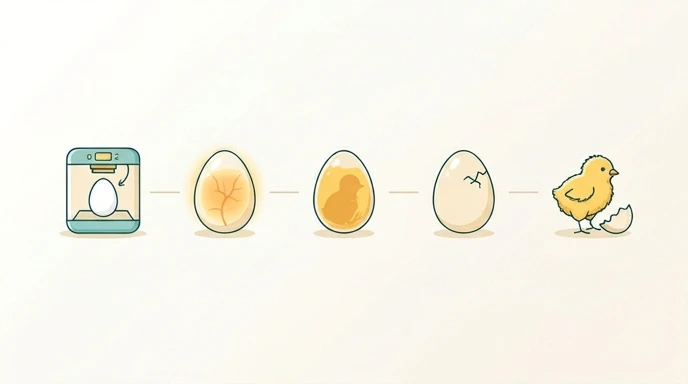
Incubation Periods by Species
Incubation length is determined mainly by species and egg size — larger eggs generally take longer. These are the standard hatchery averages used to predict hatch day. Actual hatch can vary by ±1-2 days depending on incubator temperature and humidity.
| Species | Average Incubation (days) | Typical Range (days) | Group |
|---|---|---|---|
| Coturnix Quail | 18 | 17-18 | Game bird |
| Pigeon / Dove | 18 | 17-19 | Pigeon |
| Chicken | 21 | 20-22 | Poultry |
| Bantam | 21 | 20-21 | Poultry |
| Bobwhite Quail | 23 | 23-24 | Game bird |
| Pheasant | 24 | 23-25 | Game bird |
| Duck (most) | 28 | 26-28 | Waterfowl |
| Turkey | 28 | 27-28 | Poultry |
| Guinea Fowl | 28 | 26-28 | Poultry |
| Peafowl | 28 | 28-30 | Game bird |
| Goose | 30 | 28-34 | Waterfowl |
| Muscovy Duck | 35 | 33-35 | Waterfowl |
| Ostrich | 42 | 42-46 | Ratite |
| Emu | 52 | 48-52 | Ratite |
Stages of Egg Incubation
A developing embryo passes through predictable stages. The timings below are for a 21-day chicken egg; scale them proportionally for other species.
- Days 1-3:
The embryo's heart, blood vessels and head begin forming. Eggs must be turned regularly to keep the embryo centered.
- Day 7 (first candling):
A network of blood vessels and a dark embryo with a beating heart should be visible. Clear eggs are infertile and can be removed.
- Days 8-14:
Feathers, beak and claws develop. The air cell at the large end of the egg enlarges as moisture is lost.
- Day 14 (second candling):
The embryo fills most of the egg; only the air cell stays clear. Confirm a properly sized air cell.
- Day 18 (lockdown):
Stop turning, increase humidity to 65-70%, and leave the incubator closed. The chick moves into hatching position.
- Days 20-21 (hatch):
The chick pips the air cell, then the shell, and works its way out over 12-24 hours.
Candling and Lockdown Explained
Two routine checkpoints make incubation more reliable: candling (shining a light through the shell to view development) and lockdown (the final no-turn stage).
- Candling:
Use a bright, focused light in a dark room. Healthy embryos show spidery red veins and a moving dark mass. Do it quickly to avoid chilling.
- First candling (~1/3 through):
Remove clear (infertile) eggs and any with a blood ring (early death) to prevent rot.
- Second candling (~2/3 through):
Confirm a large embryo and a clear, correctly sized air cell.
- Lockdown (3 days before hatch):
Stop turning so the chick can orient, and raise humidity to soften the membranes. Resist opening the incubator.
- Hatch window:
Treat the hatch date as a ±1-2 day window — temperature swings shift it earlier or later.
Do not help a chick out of the shell unless it has been pipped for more than 24 hours — assisting too early can cause fatal bleeding.
Temperature & Humidity Targets
Accurate hatch prediction assumes correct incubator settings. Most poultry eggs incubate at the same temperature; humidity rises for lockdown.
- Forced-air incubator:
99.5 °F (37.5 °C) throughout incubation
- Still-air incubator:
101-102 °F (38.3-38.9 °C) measured at the top of the eggs
- Humidity days 1-18:
45-55% relative humidity
- Humidity during lockdown:
65-75% relative humidity
- Turning:
at least 3-5 times per day (odd number) until lockdown
A 1 °F drop can delay hatch by a day; a 1 °F rise can advance it and reduce hatchability
Waterfowl (duck, goose) benefit from daily cooling and misting after the first week, mimicking a hen leaving the nest.
Air Cell Growth & Target Weight Loss
A fertile egg must lose moisture during incubation so the air cell grows large enough for the chick to take its first breath. Aim for 11-13% total weight loss from set to lockdown — too little means humidity is too high, too much means it is too low. Track it by weighing eggs or candling the air cell.
- Day 0:
air cell is small, at the large (blunt) end of the egg
- Day 7:
air cell clearly defined, embryo and veins visible
- Day 14:
air cell larger; embryo fills roughly two-thirds of the egg
- Day 18 (lockdown):
air cell should occupy about one-third of the egg and tilt down on one side ('drawdown')
- Too-small air cell:
lower humidity 5-10% for the next few days
- Too-large air cell:
raise humidity to slow further moisture loss
Trace the air cell outline on the shell in pencil at each candling — a growing, correctly sized outline is the best non-destructive sign of healthy moisture loss.
Broody Hen vs Incubator
You can hatch eggs naturally under a broody hen or artificially in an incubator. The hatch date is the same — set date plus the species incubation period — but the management differs.
Broody hen: count day 0 as the day she commits to sitting full-time (overnight on the nest). She handles turning, temperature, humidity and cooling instinctively.
Incubator: count day 0 as the moment eggs reach temperature. You must control turning, temperature and humidity precisely.
Hens can typically cover 8-12 standard eggs; do not overload her or outer eggs will chill.
Mark broody-set eggs in pencil so you can remove any new eggs other hens add to the clutch.
Incubators allow candling and staggered sets; a hen should not be disturbed repeatedly.
If a broody hen abandons the nest mid-incubation, eggs can often be rescued in an incubator if moved quickly and still warm.
Storing Eggs Before You Set Them
Hatching eggs can be collected and stored for several days before the set date so they all start — and hatch — together. Storage quality strongly affects hatch rate.
Store pointed end down at 55-65 °F (13-18 °C) and 70-75% humidity
Tilt or turn stored eggs once daily to keep the yolk centered
Best hatch from eggs set within 7 days; hatchability drops noticeably after 10 days
Let cold-stored eggs warm to room temperature before setting to avoid condensation
Do not wash hatching eggs — washing removes the protective bloom (cuticle)
Discard cracked, misshapen, or very dirty eggs
Hatch Day: From Pip to Zip
Hatching is a 12-24 hour process once it begins. Knowing the sequence helps you avoid intervening too early.
- Internal pip:
the chick breaks into the air cell and starts breathing air; you may hear peeping
- External pip:
a small crack or hole appears in the shell — this can be 12-24 hours before full hatch
- Resting:
chicks pause for hours after pipping while absorbing the remaining yolk — this is normal
- Zip:
the chick rotates and cuts a ring around the shell, then pushes the cap off
- Dry-off:
leave the chick in the warm incubator for 6-12 hours until fluffy before moving to the brooder
Only consider assisting if a chick has externally pipped but made no progress for more than 24 hours, and the membrane has turned dry and brown.
After the Hatch: Brooder Setup
Chicks need a warm, dry brooder once they are fluffed and standing. Plan this before the hatch date the calculator gives you.
Brooder temperature: start at 95 °F (35 °C) for week 1, reduce by 5 °F each week until matching ambient
Provide chick starter feed and clean, shallow water with marbles or stones to prevent drowning
Allow at least 0.5 sq ft per chick for the first weeks, increasing as they grow
Watch chick behavior: huddling under the heat = too cold; spread to edges = too hot
Newly hatched chicks can go 24-48 hours on absorbed yolk, so latecomers can finish hatching first
Staggered Hatches & Mixed Species
Setting eggs on different dates (a staggered hatch) keeps a steady supply of chicks but complicates lockdown, because you should not open the incubator while other eggs are hatching.
Use a separate hatcher unit for eggs in lockdown so the main incubator can keep turning new sets
When mixing species, back-calculate set dates so all eggs reach lockdown on the same day
Example: to hatch duck (28d) and chicken (21d) together, set the duck eggs 7 days before the chicken eggs
Label every egg with species and set date in pencil
Prioritize the highest-humidity requirement at a shared lockdown
Common Hatching Mistakes
Avoid these frequent errors that throw off the hatch date or reduce hatch rates.
Counting the set day as day 1 — day 0 is the set day, so a 21-day egg set on the 1st hatches on the 22nd of the month
Opening the incubator during lockdown — the humidity drop can shrink-wrap chicks in their membranes
Turning past day 18 — this prevents the chick from orienting to pip
Using the wrong species period — duck eggs set on a 21-day chicken schedule will appear 'overdue' for a week
Ignoring temperature drift — verify with a second calibrated thermometer
Helping too early — premature assistance is the leading cause of hatch losses
Quick Reference Card
Egg Hatch — Quick Reference
Quick reference • Egg Hatch Date Calculator
Hatch Date = Set Date + Incubation Days (±1-2 days)Valid range: 18-52 days depending on species
Common Values
⚠ Watch Out
- •Day 0 is the set day — do not count it as day 1
- •Stop turning at lockdown (3 days before hatch)
- •Do not open the incubator during lockdown
- •Match the incubation period to the correct species
Pro Tips
- →Candle on day 7 and day 14 to cull clear or dead eggs
- →Keep a forced-air incubator at 99.5 °F (37.5 °C)
- →Raise humidity to 65-75% at lockdown
- →Allow 2-3 extra days before giving up on overdue eggs
FAQs
How long does it take for a chicken egg to hatch?
A chicken egg takes 21 days to hatch under correct incubation (99.5 °F / 37.5 °C in a forced-air incubator). Counting the set day as day 0, an egg set on June 18 will hatch around July 9. Hatch can vary by ±1-2 days depending on temperature and humidity.
What day do I stop turning eggs (lockdown)?
Stop turning 3 days before the expected hatch date. For chickens that is day 18, for ducks around day 25, and for quail around day 15. At lockdown you also raise humidity to 65-75% and keep the incubator closed so the chicks can pip and hatch.
When should I candle my eggs?
Candle around one-third and two-thirds of the way through incubation. For chickens, candle on day 7 (look for veins and a beating heart) and day 14 (confirm a growing embryo and clear air cell). Remove clear infertile eggs to prevent them rotting and contaminating the incubator.
Do different birds have different incubation periods?
Yes. Incubation ranges from 18 days (coturnix quail, pigeon) to 52 days (emu). Common values: chicken 21, pheasant 24, duck and turkey 28, goose 30, Muscovy duck 35, and ostrich 42 days. Larger eggs generally take longer to hatch.
How accurate is an egg hatch date calculator?
It is accurate to within ±1-2 days if you know the exact set date and maintain correct incubator temperature and humidity. The main sources of variation are temperature drift (a 1 °F change shifts hatch by about a day), humidity, and egg size within a species.
Can I incubate eggs from different species together?
It is possible but not ideal, because species need different incubation periods and lockdown days. If you must mix, set eggs so they reach lockdown around the same time (for example, set duck eggs 7 days before chicken eggs) and prioritise the longest-incubating species for humidity at lockdown.
What happens if eggs are overdue?
Give eggs an extra 2-3 days past the calculated hatch date before giving up, as cooler incubation can delay hatching. Candle late eggs to check for movement. If there is no internal pip and no movement by 3 days past due, the embryo has likely stopped developing.
How long can I store eggs before incubating them?
For the best hatch rate, set eggs within 7 days of collection. Store them pointed-end down at 55-65 °F (13-18 °C) and around 70-75% humidity, tilting them once a day. Hatchability falls noticeably after 10 days and drops sharply beyond 2 weeks. Always let stored eggs warm to room temperature before setting.
Why didn't my eggs hatch?
The most common causes are incorrect temperature (the biggest factor), wrong humidity, infertile eggs, irregular turning, or old/poorly stored eggs. Candling at day 7 and 14 helps identify infertile or early-dead eggs. Performing an eggtopsy (carefully opening unhatched eggs afterward) can reveal whether they were infertile or at what stage development stopped.
Do I need to turn the eggs during incubation?
Yes — turn eggs at least 3-5 times a day (an odd number, so they rest on alternate sides each night) from day 1 until lockdown. Turning stops the embryo from sticking to the shell membrane. An automatic egg turner does this for you. Stop all turning 3 days before hatch so the chick can orient itself to pip.
Can you eat an egg that didn't hatch?
No. Eggs that have been through days of incubation should not be eaten — they may contain a partially developed embryo or have begun to spoil at incubation temperature. Discard all unhatched incubated eggs. Only never-incubated, properly stored eggs are safe to eat.
Is day 0 or day 1 the day I set the eggs?
Treat the set day as day
- 1A 21-day chicken egg set on the morning of June 18 reaches day 21 — and hatches — around July
- 2Counting the set day as day 1 will make you expect hatch a day too early, which matters most when timing lockdown